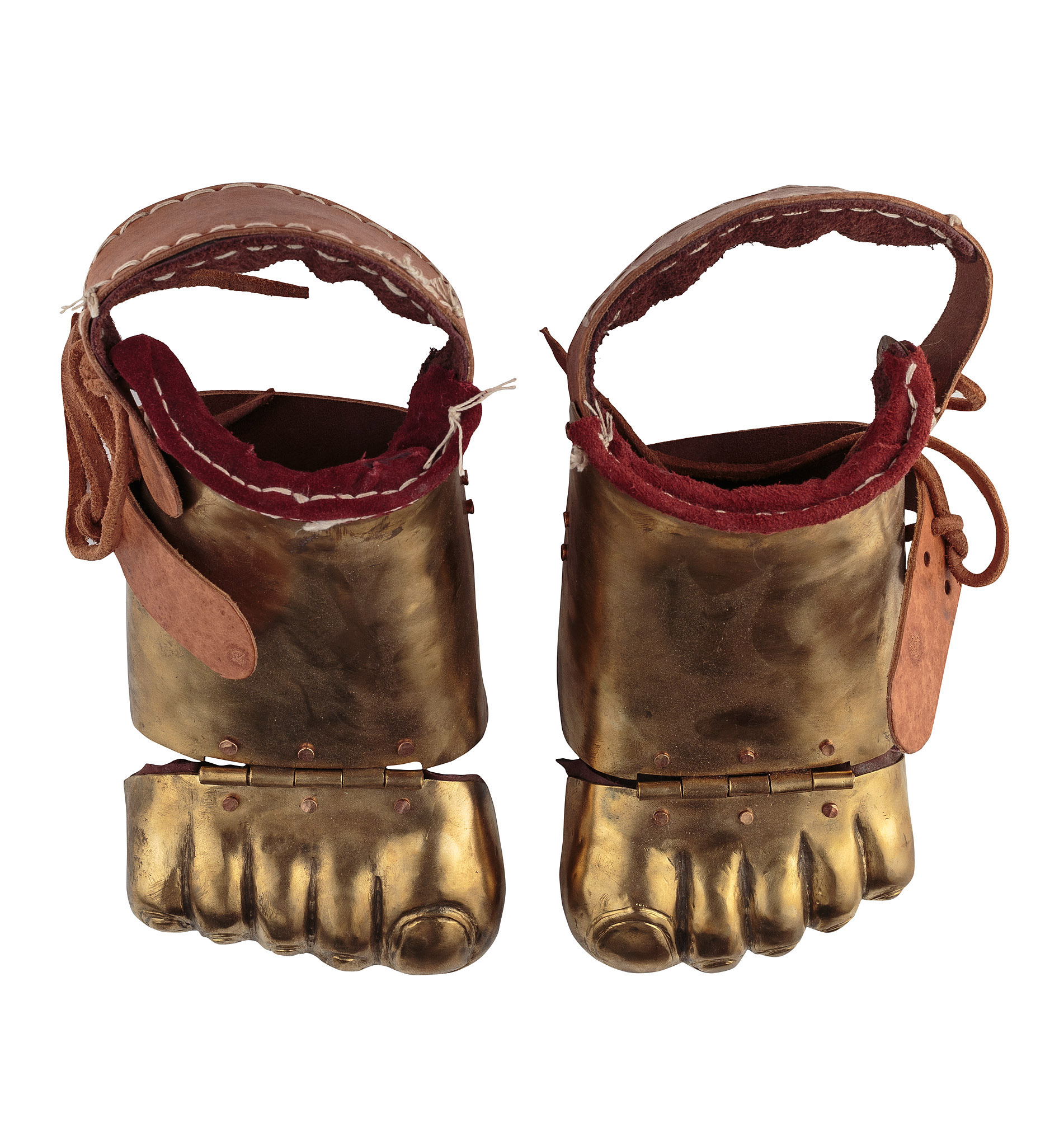
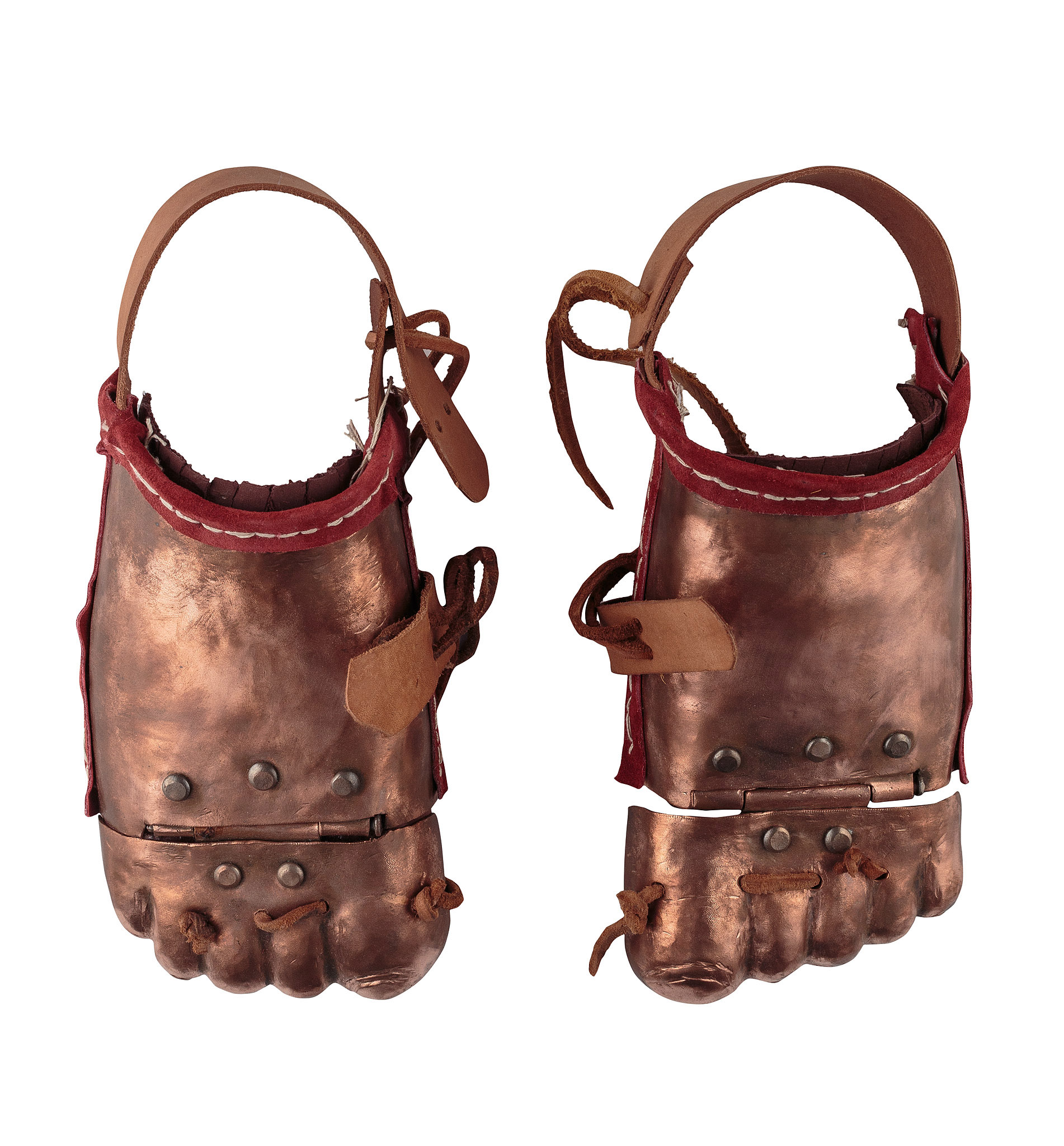
A pair of articulated foot guards with sculpted toe caps, hinged instep plates and ankle straps. Designed and art-directed by Archaeopolis and handcrafted by Dimitris Katsikis, available by commission at €2,500 per pair.
Design & art directionGeorgios Katsos / ArchaeopolisMakingDimitris Katsikis
Archaeopolis articulated foot guards, front view showing sculpted toe caps, hinges and ankle straps
Design authorship & making
Historical reference. Contemporary craft.
The design concept and aesthetic direction of this series belong to Georgios Katsos and Archaeopolis. The objects are physically handcrafted by Dimitris Katsikis within that creative framework.
The photographed pair has sculpted toe caps, a hinge across the forefoot, an instep shell, ankle straps and a visible inner lining. These are the documented features of the contemporary Archaeopolis interpretation.
The price is €2,500 per pair, made to order. Exact alloy, lining composition, dimensions, fit and production schedule are agreed with the workshop before ordering. The archaeological photographs below document ancient comparanda and are not images of the item for sale.
Archaeological references
Armour shaped around the foot.
Ancient comparanda for a contemporary interpretation. The museum objects shown here are historical evidence, separate from the Archaeopolis pair offered for sale.
Ancient bronze foot-guards from Ruvo, Greek or Italian, c. 520–480 BCE. British Museum, 1856,1226.714. Photograph: Gre regiment / Wikimedia Commons, CC BY-SA 4.0. Unmodified photograph.
The Ruvo foot-guards
A particularly close comparison is the pair of bronze foot-guards from Ruvo in southern Italy, now in the British Museum. Dated to around 520–480 BCE and described as Greek or Italian, they cover the upper foot and reproduce the toes in metal. Hinges connect the toe plates to the instep sections.
The combination of anatomical modelling and articulation makes them relevant to the sculpted, hinged form of the Archaeopolis pair. This is a comparison of visible construction; it does not establish an exact reproduction of this specific ancient object.
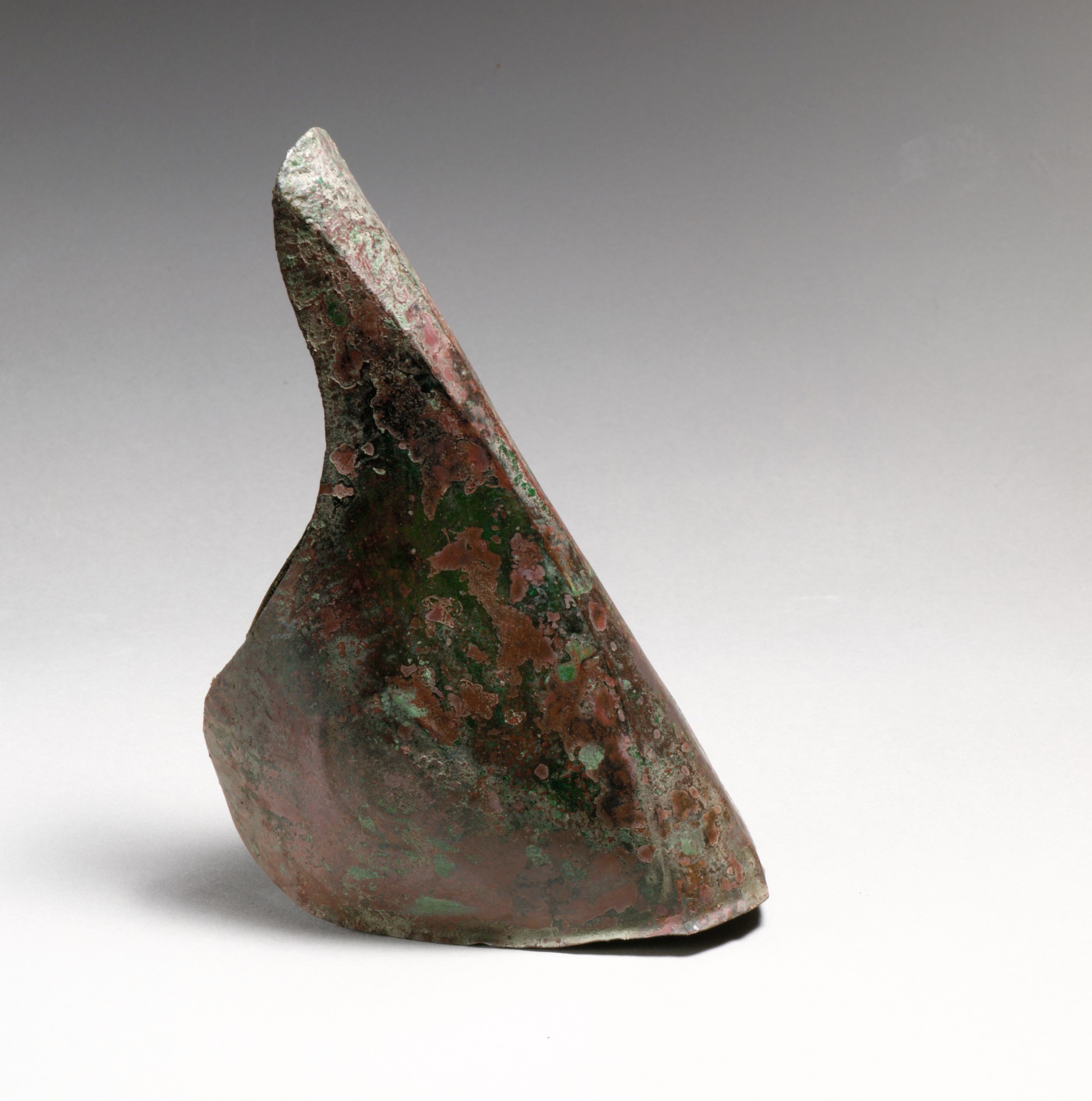
Bronze ankle guard from a pair, Greek, 5th century BCE. The Metropolitan Museum of Art, 1982.11.5, .6. Met Open Access / CC0. This photograph shows one guard from the pair.
Foot armour and ankle protection
Ancient armour also included specialised protection around the ankle. The Met’s fifth-century BCE pair belongs to this related category: ankle guards covering the area below the greave. They are a different form from the hinged toe-and-instep guards shown above.
Comparing the two helps distinguish the parts of the body protected by supplementary armour. The Met records lengths of 23.2 cm and 22.7 cm for its ancient pair. Those are museum-object measurements, not sizing specifications for the Archaeopolis commission.
Foot-guards are rare finds. In his study of south Italic armour, Michael Burns discusses the Ruvo pair’s hinges, modelled toes and possible lining attachments. Their perforations may relate to an inner lining; the surviving metal leaves aspects of original fit, padding and attachment open to interpretation. See Burns, 2006, section 4.11.
“Hoplite Shoes” is the Archaeopolis collection name. It should not be read as a claim that every Greek hoplite wore this type of foot armour. The photographed modern straps, inner lining and finish belong to the contemporary workshop interpretation.
For further discussion of supplementary armour and ankle guards: Dietrich von Bothmer, Armorial Adjuncts, Metropolitan Museum Journal 24 (1989), pp. 65–70.
Complete surviving set · 2 photographs
The documented object series.
Every photograph in the identified source folder is preserved here. Captions remain deliberately factual until object-level technical documentation is complete.
001Archaeopolis articulated foot guards, front view showing sculpted toe caps, hinges and ankle strapsDesign: Archaeopolis · Making: Dimitris Katsikis002Archaeopolis articulated foot guards, second workshop viewDesign: Archaeopolis · Making: Dimitris Katsikis