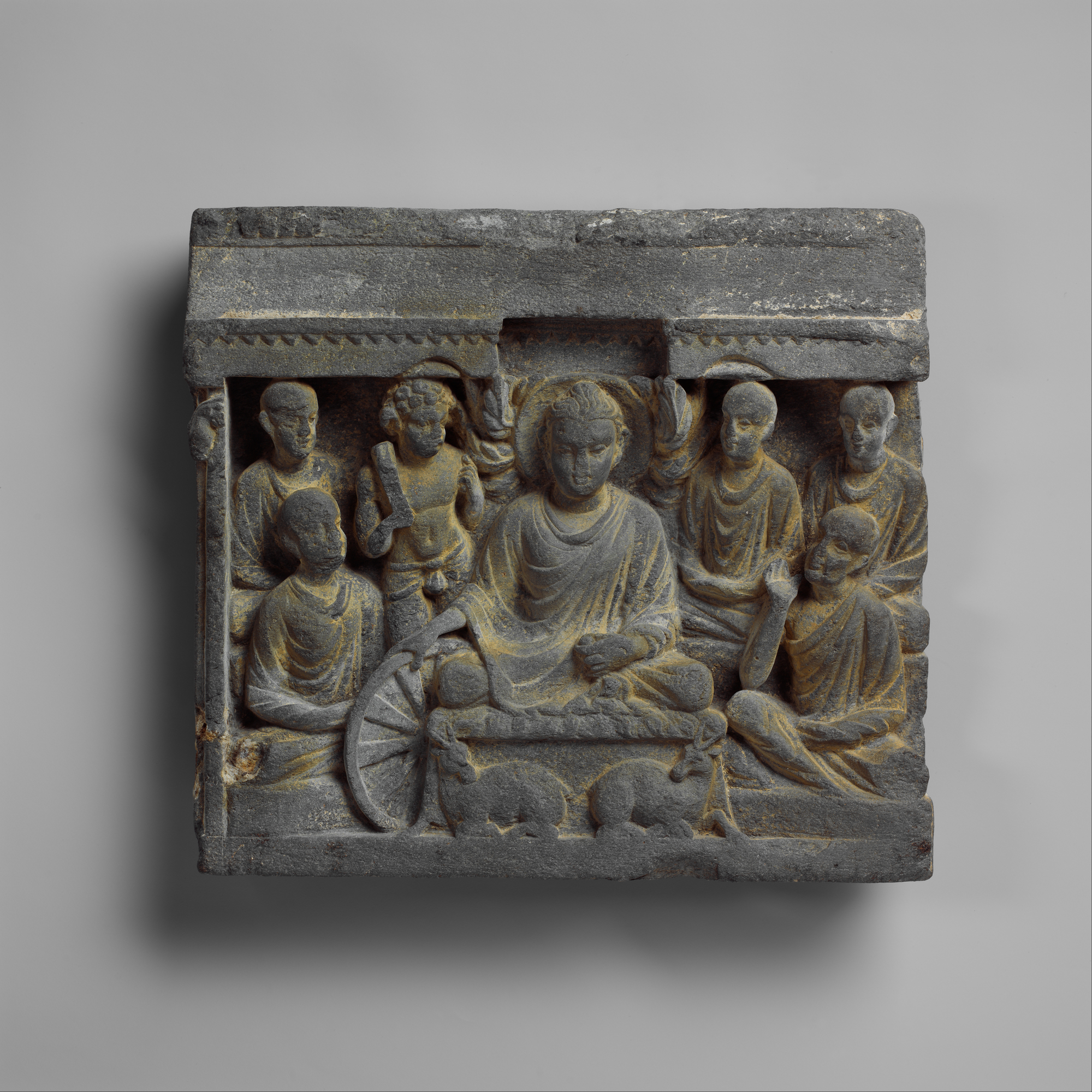
The stone figure that contains two worlds
In a second-century relief from ancient Gandhara, the Buddha sits at the centre of the First Sermon. Beside him stands a compact, powerfully built guardian. The attendant is Vajrapani, bearer of the vajra and protector of the Buddha. Yet his body, stance and physical authority recall another figure whose image had travelled thousands of kilometres from the Mediterranean: Herakles. The thunderbolt has replaced the club, but the visual memory of the Greek hero remains visible.
This object is not a curiosity at the margins of history. It is evidence of a world in which forms, stories, artisans and political ideas moved across enormous distances. It asks us to abandon the comfortable image of ancient civilisations as sealed containers. Hellenistic, Iranian, Central Asian and Indian communities did not meet only on battlefields. They met in cities, workshops, courts, markets and religious foundations. Gandharan art records that encounter in stone.
From Alexander's campaign to a Hellenistic East
Alexander reached the north-western regions of the Indian subcontinent in the late fourth century BCE. His campaign was brief, violent and politically unstable; it did not create a permanent Greek empire in India. Its importance lies partly in the routes and political possibilities it exposed. After Alexander's death, new kingdoms emerged across territories stretching from the eastern Mediterranean through Iran and Central Asia. Greek-speaking rulers, local dynasties and mobile populations negotiated power in an environment that no single culture controlled.
The Seleucid and Mauryan worlds established diplomatic relations. Later, Greco-Bactrian and Indo-Greek kingdoms developed in regions that now belong to Afghanistan, Pakistan and northern India. Their coins paired Greek legends with local scripts, Greek deities with Indian symbols, and portraits of rulers with titles meant for different audiences. A coin is a political object, but it is also a small public declaration: authority here had to communicate across cultures.
Gandhara was a crossroads before it became a label
Gandhara occupied a strategic zone around parts of present-day northern Pakistan and eastern Afghanistan. Roads connected it with the Indian plains, the Iranian plateau, Central Asia and, indirectly, the Mediterranean. Armies passed through, but so did merchants, monks, craftsmen, diplomatic missions and portable works of art. Under the Kushans, especially in the first centuries CE, Buddhist institutions flourished within this internationally connected environment.
When modern writers call its sculpture Greco-Buddhist, the phrase can be helpful—but only if it describes an encounter rather than assigns ownership. Gandharan workshops did not simply attach Buddhist names to Greek statues. They selected from an available international vocabulary: classical drapery, naturalistic anatomy, architectural ornament, Iranian courtly forms, Indian religious symbols and regional workshop practices. Their art is powerful because it is synthetic without being anonymous. It belongs to Gandhara.
Before the Buddha had a human face
Some of the earliest surviving Buddhist monuments evoke the Buddha without showing him bodily. An empty throne, a wheel, footprints, a riderless horse or the Bodhi tree can announce his presence. These signs do not prove that artists were forbidden to portray him; they reveal a sophisticated symbolic language in which absence could be meaningful.
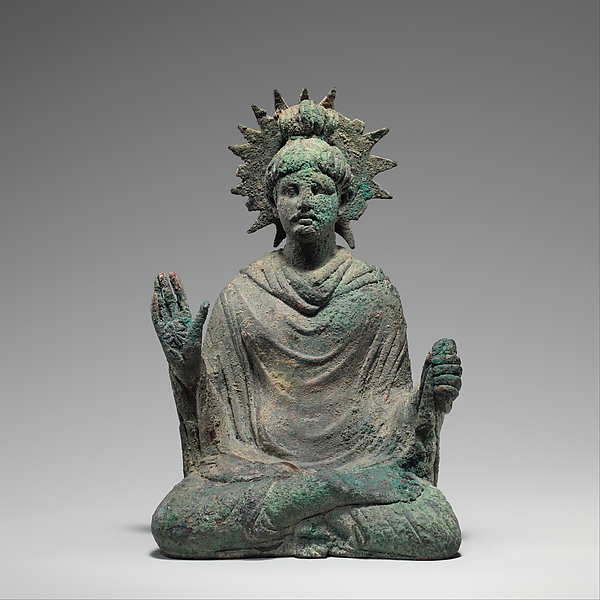
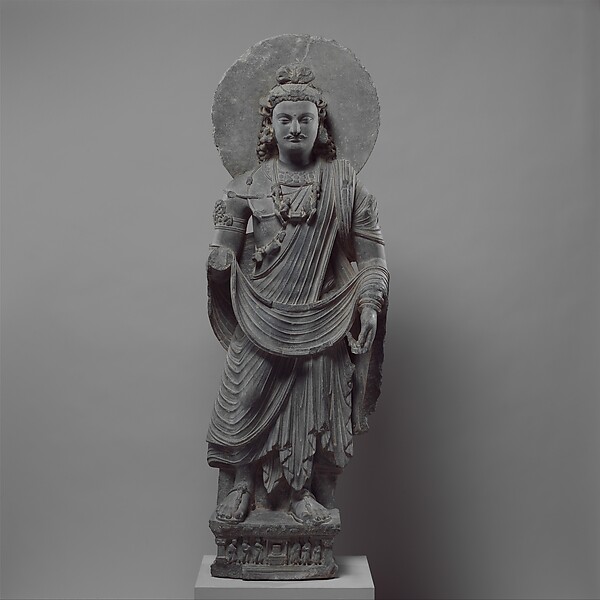
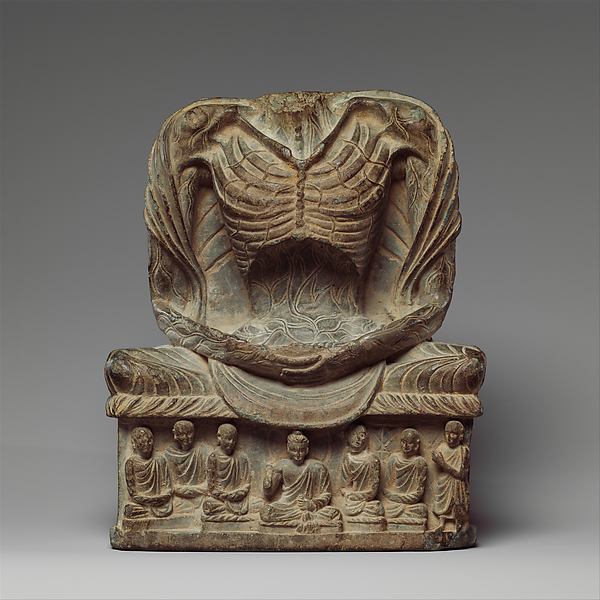
By the early centuries CE, anthropomorphic images of the Buddha appeared prominently in both Gandhara and Mathura. The two centres did not produce identical figures. Mathuran images drew strongly on established Indian sculptural traditions. Gandharan Buddhas often wore heavy monastic robes articulated in rhythmic folds, with carefully modelled faces and wavy hair that invited comparison with Mediterranean sculpture. The human Buddha was therefore not the invention of one imported civilisation. It emerged within several artistic environments responding to new devotional needs.
The classical body, transformed
A Gandharan Buddha may look familiar to a viewer trained in Greek and Roman art: balanced posture, controlled anatomy, a robe falling in repeated folds and a face built through measured volumes. But resemblance is only the beginning. The figure's marks, gestures and spiritual function belong to Buddhism. Classical naturalism has entered a different system of meaning.
This distinction matters. Cultural exchange is sometimes described as if one side supplies the form and the other merely supplies the subject. That model reduces the receiving culture to imitation. Gandharan artists did something more intelligent. They translated. They decided which elements could communicate dignity, serenity, authority and transcendence to patrons living in a plural world. Translation changes both the borrowed form and the context that receives it.
Herakles, Vajrapani and the migration of strength
The transformation of Herakles into a visual model for Vajrapani is among the most striking examples. Herakles represented tested strength, endurance and the defeat of monstrous disorder. His muscular body, beard, contrapposto stance and club made him immediately recognisable across the Hellenistic world. In Gandharan Buddhist reliefs, a Heraklean figure can stand close to the Buddha, no longer performing the labours of the Greek hero but protecting the teacher and holding the vajra.
The point is not that Vajrapani secretly is Herakles. The point is that viewers and artists could use a prestigious image of physical power to articulate a Buddhist protector. The club becomes a thunderbolt; heroic force becomes guardianship. A foreign visual ancestor survives, yet the resulting figure serves a new theology. This is cultural transmission at its most concrete: not the survival of an unchanged symbol, but a deliberate reassignment of meaning.
Atlas beneath the sacred monument
Atlas-like figures also appear in Gandharan architectural sculpture, bent beneath the weight they support. In the Mediterranean tradition, Atlas carries the heavens. In Gandharan settings, comparable muscular bearers may support elements of a Buddhist monument. Again, the motif is neither copied mechanically nor emptied of force. Its visual logic—superhuman endurance made bodily—remains useful in a new sacred architecture.
Such figures reveal the workshop as a place of intellectual activity. Craftsmen did not require modern theories of hybridity to understand that an image could travel. They learned forms through objects, drawings, teachers, patrons and neighbouring monuments. They recombined what they knew. The resulting sculpture is an archive of decisions, even when the names and biographies of the makers have disappeared.
Dionysian abundance far from the Aegean
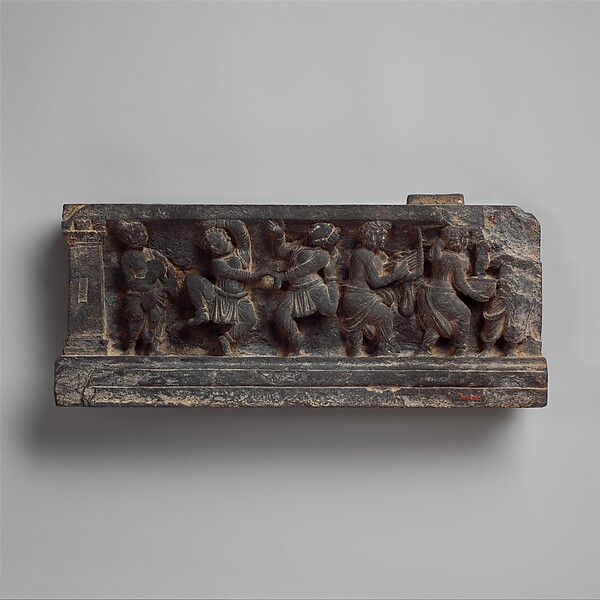
Vine scrolls, garlands, drinking figures, musicians and scenes of abundance in Gandharan art have often been connected with Dionysian imagery. The association is plausible because the Hellenistic world carried the visual language of Dionysos widely. Yet not every vine proves a Dionysian cult, and not every drinking scene preserves a Greek ritual. Motifs could outlive the precise beliefs that first organised them.
What survives is a social vocabulary of fertility, pleasure, music, procession and plenty. Within Buddhist architectural programmes, such imagery could frame sacred narratives or evoke prosperity without reproducing a Greek festival. This is another warning against simplistic conclusions. Influence is not the same as conversion, and resemblance is not proof of a single source. The history becomes richer when we ask how the motif functioned in its new setting.
Menander, Milinda and the authority of questioning
The Indo-Greek king Menander I, who ruled in the second century BCE, occupies a special place in the story. Buddhist tradition remembers a King Milinda in the Milindapanha, a text structured around his questions to the monk Nagasena. The ruler challenges definitions of personal identity, rebirth, knowledge and ethical action; Nagasena responds through argument and memorable analogies, including the famous analysis of the chariot and its constituent parts.
The text reached its surviving form through a complex literary history, so it cannot be treated as a verbatim record of a historical interview. Even so, its choice of an Indo-Greek king as the questioner is significant. The foreign ruler is not portrayed merely as an enemy or passive convert. He becomes the engine of philosophical examination. Whether or not every detail is historical, the dialogue imagines cultural encounter as disciplined questioning rather than submission.
Cynics, gymnosophists and the temptation of a grand theory
Greek sources describe encounters with Indian ascetics whom they called gymnosophists, the naked wise men. Alexander's world also included philosophers associated with Cynic traditions, most famously Onesicritus, whose reports are preserved indirectly and must be treated with caution. Comparisons between Cynic austerity and Indian renunciation are therefore understandable: rejection of luxury, indifference to convention, bodily discipline and the search for freedom appear in both conversations.
But similarity does not establish organisation, authorship or direct descent. The original 2020 study behind this essay explored the provocative possibility that Greek philosophical actors and imperial planners contributed deliberately to the religious and political transformations of the East. As a research hypothesis, that question can stimulate investigation. As a historical statement, it goes beyond the surviving evidence. We cannot presently demonstrate that a coordinated Cynic group designed Buddhism or that Alexander's staff created it as a geopolitical instrument.
Empire, religion and the limits of geopolitical explanation
Rulers have always understood that religious institutions, ethical languages and networks of pilgrimage can support political order. Ashoka's inscriptions demonstrate an imperial concern with moral governance and the communication of dhamma. Hellenistic rulers likewise used divine associations, civic cult and visual propaganda. It is therefore reasonable to ask how power interacted with religious transmission.
The danger begins when a reasonable question becomes a total explanation. Buddhism emerged from South Asian intellectual and religious conditions that predate Alexander. Its monastic structures, doctrines and debates cannot be reduced to a foreign geopolitical project. Hellenistic contact affected parts of its later material and political environment, particularly in the north-west, but contact is not creation. A credible history must be able to hold both statements at once.
What can be stated with confidence
Several conclusions rest on firm ground. Greek-speaking political communities existed in Central and South Asia after Alexander. Indo-Greek rulers communicated through mixed languages and symbols. Gandhara developed within a network linking Indian, Iranian, Central Asian and Mediterranean worlds. Gandharan Buddhist art employed recognisable classical and Hellenistic forms. Heraklean imagery informed some representations of Vajrapani, while other Mediterranean motifs entered Buddhist architectural programmes.
Other conclusions require qualification. We do not know a single inventor of the anthropomorphic Buddha. We cannot turn the Milindapanha into a court transcript. We should not interpret every formal similarity as evidence of philosophical dependence. And we must not allow modern national pride—Greek, Indian or otherwise—to claim exclusive ownership of a culture created through contact. The distinction between evidence, probability and speculation is not a weakness. It is what allows ambitious interpretation to remain credible.
From historical encounter to cultural diplomacy
The Hellenistic-Buddhist encounter offers an unusually strong foundation for cultural diplomacy between Greece and India, as well as for partnerships involving Pakistan, Afghanistan and Central Asian communities whose territories preserve much of this heritage. The subject combines globally recognisable figures with objects that make exchange immediately visible. It can address art, philosophy, religion, trade, kingship, language and migration without pretending that they tell one simple story.
A serious programme could unite loans or high-quality reproductions, digital reconstructions, maps of routes and coinage, comparisons between Gandharan and Mathuran sculpture, and public conversations among archaeologists, historians of religion and artists. The central narrative should not be 'Greece gave Buddhism its image.' A stronger and more accurate proposition is that interconnected societies developed new ways of representing sacred and political authority.
Exhibition, education and the shared table
An exhibition could begin with absence—the wheel, throne and Bodhi tree—before presenting the emergence of the human Buddha in different regions. A second movement could examine the travelling body: Buddha, Vajrapani-Herakles, Atlas-like supporters and Dionysian motifs. Coins and scripts could show that cultural negotiation also operated through administration and commerce. The visitor would leave not with a list of influences but with an understanding of translation as a historical force.
The same subject can support educational programmes, conferences, performances and carefully framed gastronomic diplomacy. Food should not be invented as an 'authentic Greco-Buddhist menu' where evidence does not permit one. Instead, a contemporary diplomatic table could interpret documented products, routes, hospitality practices and the movement of spices, grains, wine traditions and culinary ideas—clearly labelled as research-led interpretation. The meal would become a platform for conversation rather than a costume version of history.
Why the question matters now
Modern public debate often treats culture as property: who invented an image, who influenced whom, who can claim a civilisation. Gandhara offers a different model. Its greatest works are not culturally weak because they contain several inheritances. They are powerful because local artists and patrons transformed those inheritances into something appropriate to their own spiritual and political world.
That lesson is valuable beyond ancient history. Cultural diplomacy works when it creates shared attention without erasing difference. It fails when it turns complex contact into propaganda. The task is not to flatten Greece and India into an imaginary common civilisation, nor to deny the visible evidence of encounter. It is to construct an honest space in which both connection and independence can be examined.
An open research programme
This article does not close the argument developed in 2020; it reorders it. The original manuscript brought together history, geopolitics, philosophy, art, tourism and gastronomy in an attempt to imagine a large Greece-India cultural initiative. Some of its claims were deliberately bold. The public version retains the productive questions while refusing to present hypotheses as consensus.
The next stage should be collaborative: a revised bibliography, object-by-object documentation, consultation with specialists in Gandharan and South Asian studies, and a clearly structured cultural-diplomacy proposal. Archaeopolis can contribute the connective method—turning research into exhibition, material environment, food interpretation and public experience—while scholarship sets the evidentiary boundaries. That is the more durable legacy of the encounter: not a claim of possession, but an invitation to investigate together.
Evidence sets the boundaries. Production gives the encounter its life.
Selected sources and further reading
Editorial standard: this article distinguishes broad historical evidence from Archaeopolis production practice. Specific dates, artefacts and quotations will only be added with named sources.