Production Radar · Documentary series · 2025
Ancient Greece: The Dark Chronicles (2025)
Five episodes from the Bronze Age to Alexander, exploring the violence, ambition and inequality behind ancient Greece.
Five episodes trace Greek history from the Bronze Age to Alexander, with a closer look at the violence, ambition and inequality behind one of the world's most celebrated civilisations.
Ancient Greece gave the world extraordinary ideas about politics, philosophy, science and art. It also produced societies built around conquest, slavery, ruthless competition and struggles for power.
Ancient Greece: The Dark Chronicles, known in Germany as Dark Greece: Die Wahrheit über das antike Griechenland, explores these contradictions in a five-part documentary produced by Gruppe 5 for ZDFinfo, with international distribution through ZDF Studios.
First broadcast in 2025, the series follows the ancient Greek world from the palaces of Bronze Age Crete and Mycenae to the conquests of Alexander the Great.
Rather than treating Greek civilisation as a succession of familiar achievements, the documentary asks what those achievements cost, who benefited from them and who was excluded.
The result is a history in which democracy exists alongside slavery, athletic competition reflects political rivalry, and the cultural brilliance of Athens coexists with imperial ambition.
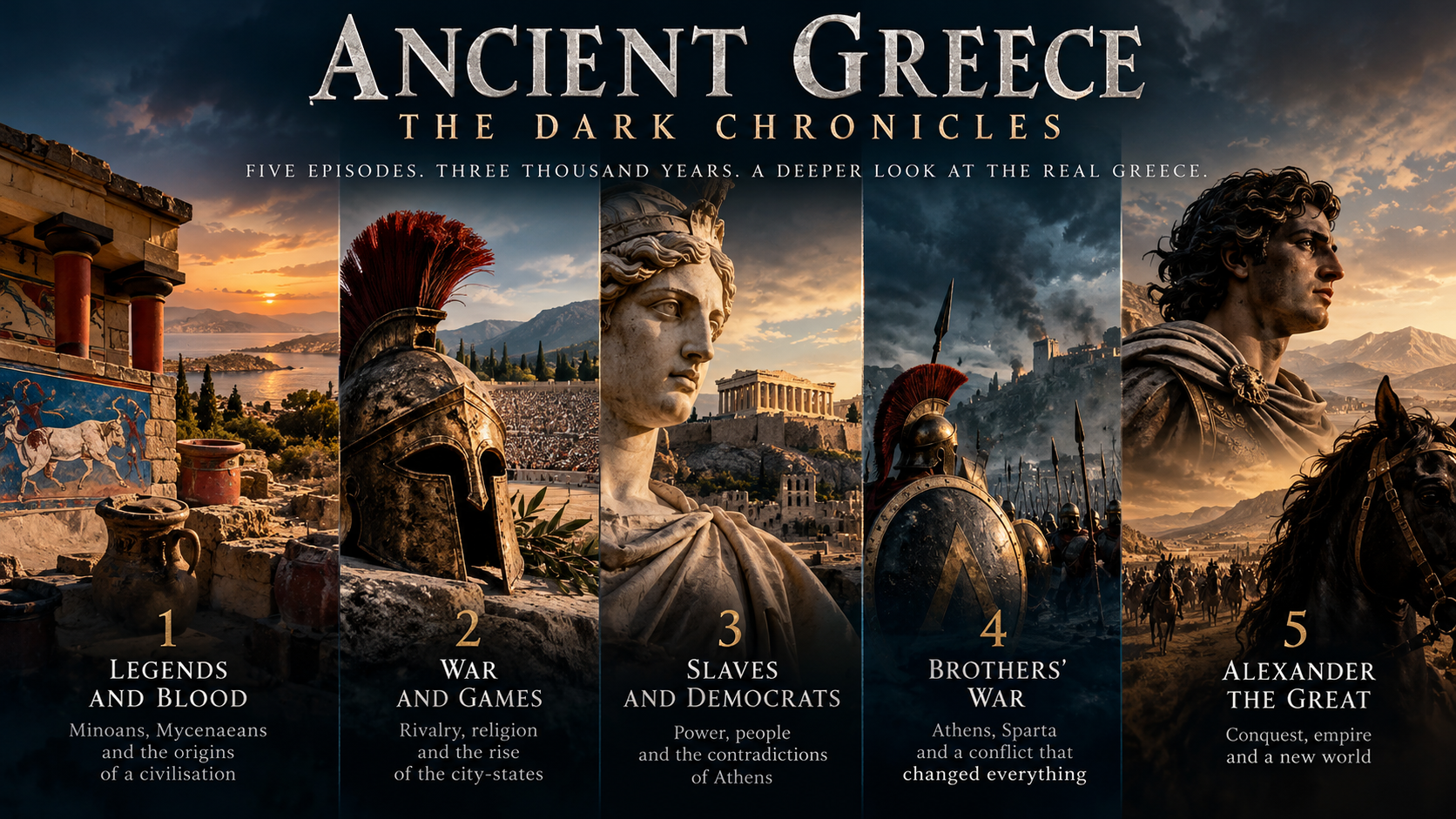
What Is Ancient Greece: The Dark Chronicles About?
The series covers five major periods of Greek history, each revealing a different relationship between power, society and violence.
Its historical journey begins with the Minoans and Mycenaeans, moves through the formation of the Greek city-states and the rise of Athens, examines the devastating war between Athens and Sparta, and concludes with Macedonia's transformation into an imperial power.
The official production description presents researchers, archaeological evidence and historical reconstructions as part of the series.
The central attraction is not simply the darker side of Greece. It is the contrast between the civilisation remembered today and the complicated historical reality behind that reputation.
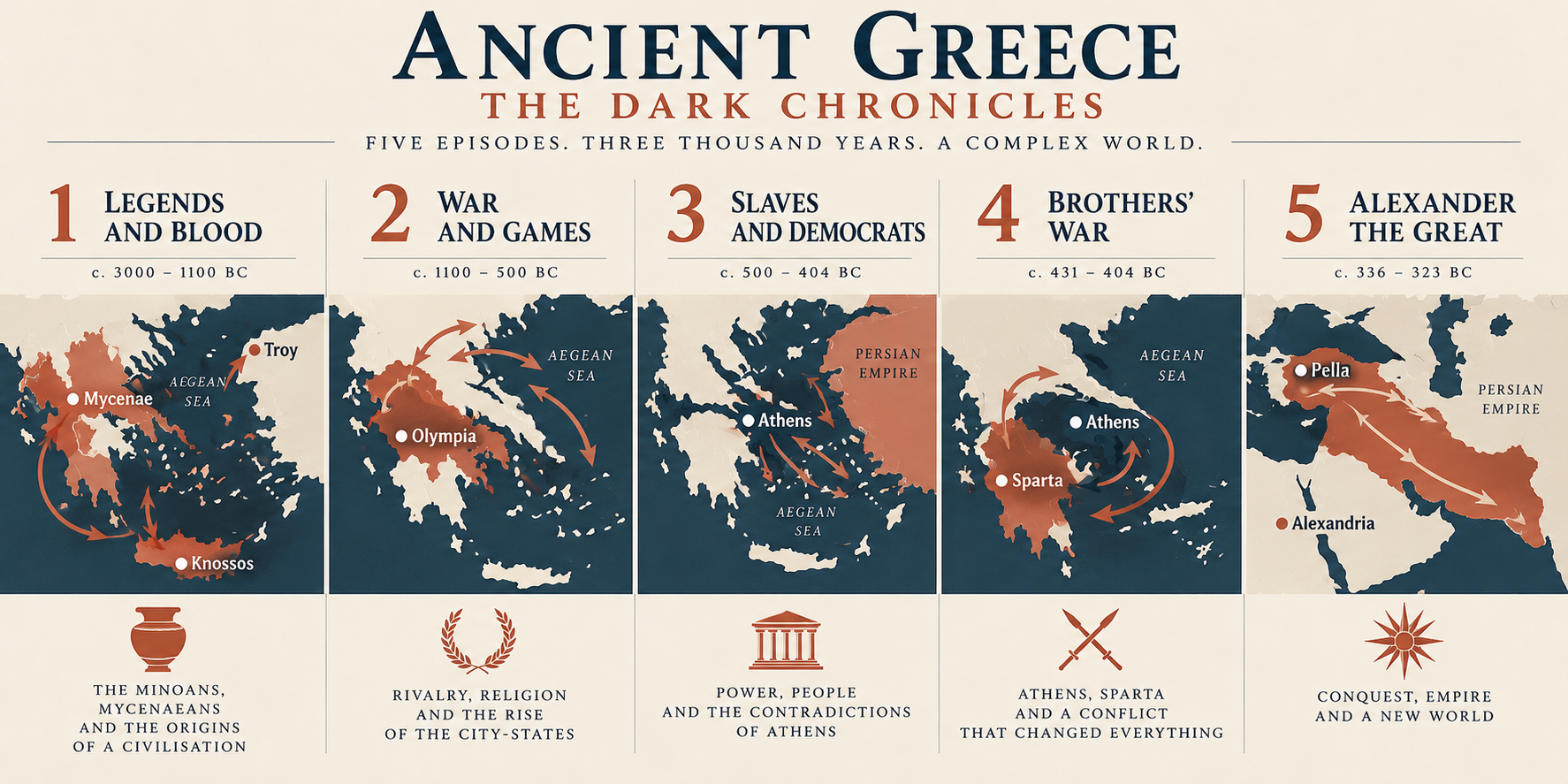
The Five Episodes
Episode 1: Legends and Blood
Long before Athens built the Parthenon, the Aegean was home to sophisticated Bronze Age societies.
On Crete, the Minoans developed monumental palace complexes, elaborate artistic traditions and extensive maritime connections. On mainland Greece, the Mycenaeans established fortified centres whose political and military culture would leave a lasting impression on later Greek traditions.
The first episode examines these early civilisations and the relationship between archaeology, mythology and the origins of Greek society. For another treatment of this period, see Empire Builders: The Ancient Greeks.
One of the most intriguing questions concerns continuity. How closely were the inhabitants of Bronze Age Greece connected to the Greeks of the classical period?
Modern genetic research has added an important dimension to this discussion. A 2017 ancient DNA study found evidence of population continuity, alongside later admixture; its sample and methods cannot by themselves establish unbroken cultural identity.
Genetic continuity, however, does not mean that language, political institutions or cultural identity remained unchanged.
Independent historical context: The Greeks could read and write centuries before the classical alphabet appeared.
Mycenaean administrators used a writing system now known as Linear B, primarily to record economic and administrative information, as The Met explains.
When Michael Ventris deciphered Linear B in 1952, scholars discovered that its language was an early form of Greek.
This transformed the historical picture. Greek was already being written in the second millennium BC, long before the emergence of the alphabet used by Homeric and classical Greek communities.
The discovery also revealed something unexpected about the surviving texts: many were not poetry or philosophy, but inventories, allocations and records of palace administration.
The earliest surviving written Greek tells us a remarkable amount about bureaucracy.
Episode 2: War and Games
After the collapse of the Mycenaean palace system, the Greek world underwent centuries of political, economic and social transformation.
New communities emerged, maritime connections expanded, and the institutions associated with the Greek city-state gradually took shape.
Competition became one of the defining features of Greek society.
Cities competed for influence, territory and prestige. Aristocratic families competed for status. Athletes represented both personal achievement and the reputation of their communities.
The Olympic Games, traditionally dated from 776 BC, belonged to a wider religious and competitive culture that brought Greeks together while reinforcing rivalries between them.
The second episode explores this tension between a shared Greek identity and persistent political fragmentation.
Independent historical context: The Olympic Games were religious ceremonies as well as athletic contests.
The ancient Olympics took place at Olympia in honour of Zeus.
Victory brought extraordinary prestige, but the competition existed within a sacred festival rather than a modern sporting institution.
Athletes competed as individuals, although their success could bring considerable honour to their home cities.
The Olympic truce is often misunderstood as a general suspension of warfare throughout Greece. Its principal purpose was to protect participation in the festival and safe passage to Olympia, not to end every conflict between Greek states, as the Olympic Studies Centre explains.
This distinction reveals a central contradiction of the ancient Greek world. Communities could recognise common religious institutions while continuing to fight one another.
Episode 3: Slaves and Democrats
Athens occupies a privileged place in the history of political thought.
During the late sixth and fifth centuries BC, the city developed institutions that allowed eligible male citizens to participate directly in collective political decisions.
The reforms associated with Cleisthenes helped establish the foundations of Athenian democracy. Later developments expanded the role of the citizen assembly, council and popular courts.
Yet democratic participation was restricted.
Women, enslaved people and resident foreigners were excluded from citizenship and its political rights.
The third episode confronts this contradiction while following Athens through political upheaval, the Persian Wars and its emergence as a major power. Read our related Athens: Birth of Democracy feature for a different documentary approach.
Independent historical context: Democratic Athens could exercise imperial power over other Greek cities.
Following the Persian Wars, Athens became the leading member of the Delian League, an alliance originally organised around continued resistance to Persia.
Over time, Athens increasingly controlled the alliance's military resources and financial contributions.
In 454/53 BC, the league's treasury was transferred from Delos to Athens, according to The Met.
What began as a collective security arrangement developed into an empire in which allied communities faced growing Athenian demands.
The contrast is historically significant. A political system that gave its own citizens substantial opportunities for participation could simultaneously deny meaningful independence to other communities.
The history of Athenian democracy cannot be separated from the history of Athenian power.
Episode 4: Brothers' War
The Peloponnesian War was one of the most destructive conflicts of the ancient Greek world.
Beginning in 431 BC, it brought Athens, Sparta and their respective allies into a prolonged struggle that transformed the political landscape.
The war involved invasions, naval campaigns, sieges, shifting alliances and internal political conflicts.
Athens suffered a devastating epidemic early in the war. Its expedition against Syracuse in Sicily ended in catastrophe. Sparta eventually gained the upper hand, with Athens surrendering in 404 BC.
The fourth episode examines how rivalry between the leading Greek powers contributed to the breakdown of the classical political order. For the origins of the conflict, see How and Why the Peloponnesian War Started.
Independent historical context: Athens lost its democracy after losing the war.
Following the Spartan victory, an oligarchic regime known as the Thirty came to power in Athens in 404 BC.
Its rule involved political persecution, executions, confiscations and the removal of opponents.
Democratic government was restored in 403 BC after resistance to the oligarchy.
The episode's wider historical setting raises a question that extends beyond the battlefield: how resilient are political institutions when a society suffers military defeat, economic exhaustion and internal division?
Athens eventually recovered its democratic institutions, but the war had permanently altered its position in the Greek world.
Episode 5: Alexander the Great
The final episode moves north to Macedonia. Our Alexander: The Making of a God Radar entry covers a separate production about Alexander.
Under Philip II, Macedonia developed into a dominant military and political power. Philip reorganised the kingdom's armed forces, expanded its influence and defeated a coalition of Greek states at Chaeronea in 338 BC.
His son Alexander inherited a formidable military system and launched a campaign against the Persian Empire.
Alexander's victories transformed the political geography of the eastern Mediterranean and western Asia.
By the time of his death in Babylon in 323 BC, his empire extended far beyond the traditional Greek world.
Yet his achievement created a fundamental problem: how could such an enormous territory remain politically united without its conqueror?
Independent historical context: Alexander's empire began to fragment almost immediately after his death.
Alexander left no universally accepted adult successor capable of exercising effective authority over the entire empire.
His generals and other powerful figures entered a prolonged struggle for control.
The conflicts of the Successors eventually produced major Hellenistic kingdoms, including the Ptolemaic kingdom in Egypt and the Seleucid Empire in Asia. See The Met on Ptolemaic Egypt and the Seleucids.
Alexander's conquests helped spread Greek language and cultural forms across a vast geographical area, but the political unity of his empire proved short-lived.
His historical legacy was therefore not a single enduring state. It was a transformed world of interconnected kingdoms, cities, institutions and cultural exchanges.
What the Documentary Reveals About Ancient Greece
The five episodes collectively challenge the idea that ancient Greece can be understood through its most famous monuments and intellectual achievements alone.
The Bronze Age palaces reveal the importance of administration, trade and concentrated political authority.
The emerging city-states demonstrate how shared cultural traditions could coexist with intense competition.
Athens illustrates the tension between political participation and social exclusion.
The Peloponnesian War exposes the destructive consequences of rivalry between powerful communities.
Alexander's conquests show how military expansion could produce enormous cultural consequences without guaranteeing lasting political stability.
These contradictions are not incidental details. They are essential to understanding how ancient Greek societies functioned.
The documentary's value lies in encouraging viewers to examine the historical circumstances behind ideas and institutions that remain influential today. For another view of Greek landscapes and heritage, see Ancient Greece by Train.
The History Behind the Images
Historical documentaries face a challenge that is easy to overlook.
Ancient Greece did not have a single, unchanging visual identity.
The world of a Mycenaean palace was fundamentally different from classical Athens. The military equipment of an early Greek warrior differed from that of a Macedonian soldier serving under Alexander.
Architecture, clothing, weapons, domestic objects and political institutions changed over centuries.
A reconstruction can therefore be visually convincing while still combining details from different historical periods.
For viewers interested in the historical accuracy of documentary productions, it is useful to distinguish three categories of visual material.
Archaeologically documented objects are supported by surviving material evidence.
Historically informed reconstructions interpret incomplete evidence using archaeological comparisons, written sources and specialist knowledge.
Creative visualisations fill gaps that cannot be resolved conclusively from the available historical record.
All three may have a place in documentary storytelling, but they do not carry the same evidentiary weight.
This distinction becomes particularly important when a production spans the Bronze Age to the fourth century BC.
Production Details and Episode Lengths
Ancient Greece: The Dark Chronicles was produced by Gruppe 5 for ZDFinfo, in association with ZDF Studios.
The producer lists the first broadcast in 2025.
The production catalogue identifies a domestic version consisting of five episodes of approximately 45 minutes each, alongside an alternative international version of five episodes of approximately 52 minutes.
ZDF Studios also describes the series using a rounded international catalogue format of five 50-minute episodes.
These figures refer to different programme specifications and should not be mistaken for additional episodes.
The German title is Dark Greece: Die Wahrheit über das antike Griechenland.
The international title is Ancient Greece: The Dark Chronicles.
The series consists of five episodes:
- Legends and Blood
- War and Games
- Slaves and Democrats
- Brothers' War
- Alexander the Great
Who Made the Documentary?
Gruppe 5 is the production company behind the series, with ZDFinfo as broadcaster and ZDF Studios associated with its international distribution.
The producer's published episode credits identify Martin Becker among the directors and writers involved in the production.
Other published credits include cinematography by Tobias Sundermann and Leo Adass, music by Carsten Rocker, and German narration by Dörte Lyssewski.
Individual credits can differ between episodes, so the producer's episode pages remain the authoritative reference for complete personnel information.
Where Can You Watch Ancient Greece: The Dark Chronicles?
The series was produced for the German broadcaster ZDFinfo, and official programme information is available through ZDF and ZDF Studios.
The German version can be searched under Dark Greece: Die Wahrheit über das antike Griechenland.
International viewers may encounter the English title Ancient Greece: The Dark Chronicles.
Streaming access, language options and territorial rights can differ between countries and may change over time.
The official broadcaster and distributor are the most reliable starting points for checking current availability.
Official programme information:
ZDF Studios: Ancient Greece, The Dark Chronicles
Gruppe 5: Production Catalogue
Was Ancient Greece: The Dark Chronicles Filmed in Greece?
The documentary covers historical events and locations across the ancient Greek world.
However, the publicly available production information consulted for this article does not establish a complete, verified list of filming locations.
Historical locations represented on screen should not automatically be treated as confirmed shooting locations.
Documentary productions may combine location filming, archival material, visual effects, graphics and reconstructed environments.
Until independently verified production records are available, it would be misleading to identify specific Greek archaeological sites as confirmed filming locations for this series.
Why the Darker History of Greece Matters
Ancient Greek civilisation continues to influence modern discussions of democracy, political institutions, citizenship, military strategy and cultural identity.
But historical admiration can become misleading when it removes the social conditions in which those achievements developed.
The Parthenon belongs to the history of Athenian artistic and architectural achievement. It also belongs to the history of a powerful maritime empire.
The Olympic Games reflect a shared religious and cultural tradition, but they existed in a world of competing communities and frequent warfare.
Athenian democracy introduced remarkable forms of citizen participation while excluding much of the population.
Alexander's campaigns created new cultural connections while producing enormous destruction and political upheaval.
Understanding these realities does not require rejecting the achievements of ancient Greece.
It requires examining them in their historical context.
That is the more compelling story behind Ancient Greece: The Dark Chronicles.
Bringing Ancient Greece to the Screen
Recreating the ancient world requires more than recognisable temples, helmets and costumes.
The historical period, geographical setting and social context influence the appearance of nearly every object placed before the camera.
A Bronze Age palace, a classical Greek military encampment and a Macedonian royal environment demand different approaches to material culture and visual reconstruction.
Archaeopolis is an independent creative studio based in Athens, working across historical production, historically informed environments, props, equipment and immersive cultural experiences.
Our work supports the development of historical settings and visual concepts for cultural and audiovisual projects.
Explore our historical production capabilities:
Classical Greece Production Support
Archaeopolis Working Collection
For a project enquiry, contact Archaeopolis.
Archaeopolis covers Ancient Greece: The Dark Chronicles independently as part of its Production Radar. Archaeopolis does not claim involvement in the production of this documentary.
Sources
Gruppe 5 Filmproduktion
Official production overview, episode information, first broadcast year, production credits and version lengths.
ZDF Studios
International programme catalogue, official episode titles and distribution information.
ZDF Studios programme catalogue
ZDF Press Portal
Official announcement of the documentary series and its German broadcast.
Historical context
The additional historical commentary concerning Linear B, the ancient Olympic Games, Athenian democracy, the Delian League, the Thirty and Alexander's successors is independent editorial context. It is not a transcript or a claim that every detail appears on screen. The two illustrations on this page were supplied by Archaeopolis; they are editorial depictions, not official programme stills.