‘We need some Ancient Greek props’ is not yet a brief
“We need some Ancient Greek props” sounds like a simple request. It rarely is.
Does the production need a drinking cup held in close-up, fifty vessels dressing a banquet, a shield for an actor to carry all day, armour for controlled action, furniture that can survive six resets or an entire historical environment that must look convincing from every camera angle?
These are not versions of the same order. They are different production problems. Good historical prop, costume and set hire begins before anyone opens the storeroom. It begins with the period, the scene, the performer, the camera, the schedule and the exact kind of truth the production is trying to create.
A prop can be historically plausible and still fail on set. A costume can look magnificent on a mannequin and make an actor unable to sit. A set can photograph beautifully from one direction and expose a modern fire door, three cable runs and the back of a refrigerator the moment the camera moves. The objects matter. The system around them matters more.
Start with the scene, not the shopping list
The most useful first document is not a list of objects. It is a short description of what happens. Who is in the scene? What are they doing? Is the object handled, worn, struck, filled with food, exposed to fire or water, or used only as background dressing? Will the camera see it in close-up? Does it need duplicates? Will the performer rehearse with it?
“Ancient bowl — quantity 20” tells us very little. “Twenty drinking vessels for a Hellenistic banquet, six used by principal actors, two in close-up, all containing diluted wine during a night shoot” is a production brief. That information changes selection, preparation, packing, replacement planning and cost.
Before confirming availability, we need the historical period and geography, production type, dates, location access, performer measurements, intended action, camera distance, quantities, continuity requirements, exposure to food, liquids, weather or stunts, and responsibility for handling and supervision. The earlier this arrives, the more useful the collection becomes. Send the request the evening before the shoot and archaeology may be the least of our problems.
‘Ancient Greek’ covers a great deal of time and territory
Archaic, Classical and Hellenistic worlds contain different forms, technologies, military equipment, clothing choices and regional influences. The Greco-Roman and Byzantine periods introduce other visual languages. Not every scene requires a doctoral argument over a buckle, but it does require internal coherence.
The danger is often an accumulation of small contradictions: a helmet from one period, a shield from another, a garment cut according to modern fantasy, furniture borrowed from a Roman banquet and ceramic forms selected because they all looked “old”. Individually, each object may pass. Together, they create historical soup.
Research establishes the boundaries. The brief determines how strictly and visibly those boundaries need to operate. A documentary reconstruction, game launch, luxury event and dramatic television sequence do not use evidence in exactly the same way. The responsible approach states what is documented, plausible, adapted for safety or performance, or openly creative.
A hero prop is not background dressing
Objects should be classified by what the production asks them to do.
Hero objects appear prominently, are handled by principal performers or carry narrative meaning. They require close visual inspection, appropriate material, continuity preparation and often a duplicate. Action objects are carried, worn or used repeatedly; weight, balance, grip, durability and safety matter as much as appearance. An object that is correct but exhausts the performer by the fourth take is not serving the production.
Set dressing builds volume and context through vessels, baskets, textiles, tools, furniture and market material. Consumable or breakaway items belong to another category again. Collection pieces should not be quietly sacrificed to dramatic enthusiasm: the production may need replicas, expendable versions or a controlled effect developed with the relevant specialists. The words “we will be careful” are encouraging. They are not a damage-control plan.
Camera-ready does not mean museum-perfect
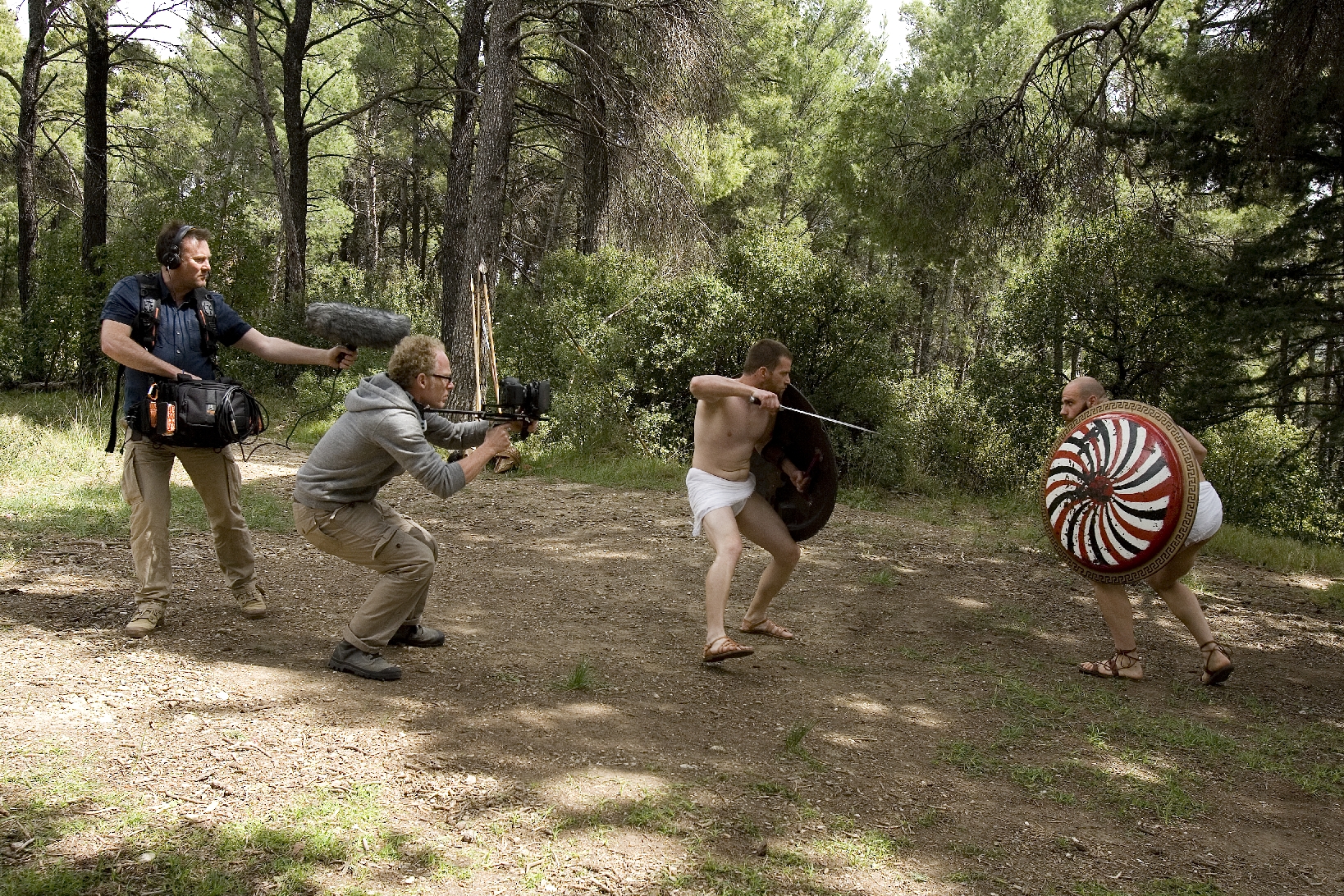
A museum object is designed to be observed. A production object has to perform. Surface texture may appear stronger under directional light, fresh materials can look sterile, colours shift through lenses and grading, and a tiny modern fastening may suddenly become the most confident object in the close-up.
Preparation may include controlled ageing, reducing shine, testing under the actual lighting, checking reflections, adapting grips or closures, preparing duplicate arrangements and photographing approved continuity states.
Ageing is not the same as covering everything with brown paint. Historical people owned new things too. Objects wore differently according to material, use and care. Random dirt is not evidence of authenticity; sometimes it is only evidence that the art department found a sponge. The aim is not to make every object look ancient. It is to make the world look inhabited.
Costume hire begins with bodies
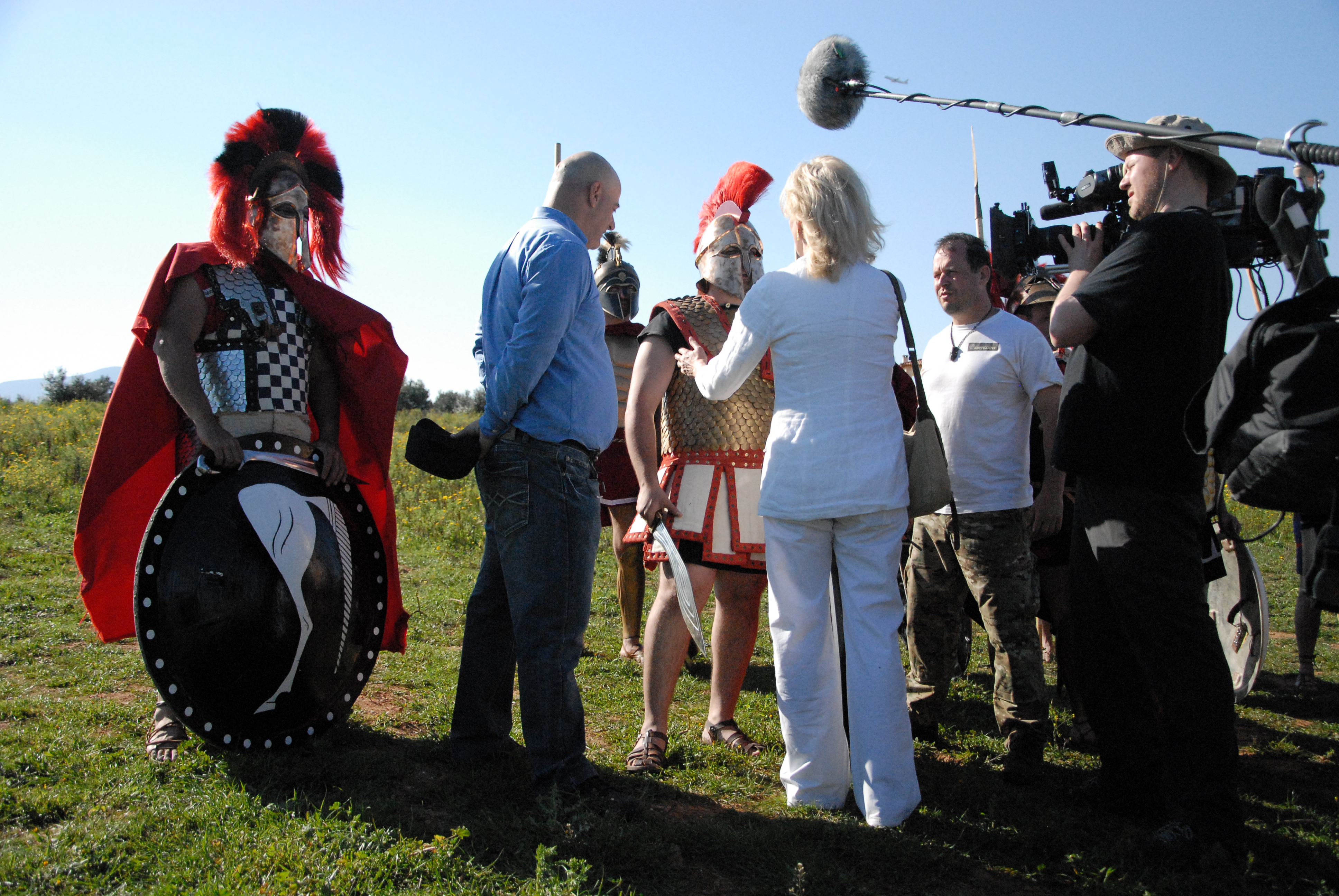
Historical clothing cannot be selected from photographs alone. We need measurements, role, movement, footwear, underlayers, temperature, dressing time and continuity. We need to know whether the performer will sit, fight, ride, run, eat, dance or spend ten hours beneath Greek summer light while everyone else discusses the monitor.
A fitting tests breathing, movement, safe hems, armour weight distribution, fastenings, repeatable resets, modesty, microphones, harnesses, sweat, dust and water. Costume is not decoration attached to an actor. It changes posture, gesture and movement. When it works, it helps the performer enter the role. When it does not, the audience watches a person negotiating privately with their own clothing.
Natural fibres, linen, leather, wool and historically informed construction behave differently from modern costume fabrics. That difference can create visual credibility, but it also requires handling, maintenance and realistic scheduling. The fitting is where historical intention meets the human being who has to wear it.
Armour and weapons require supervised use
Historical weapons and protective equipment are not ordinary decoration. Even blunt or reconstructed items can create risk through weight, edges, points, momentum, poor handling or confusion on a busy set. Intended use must be agreed in advance and coordinated with the production’s safety, stunt and insurance procedures.
The brief must identify display-only and action items, authorised handlers, planned movement or contact, required supervision, storage between takes, inspections and safe substitutes. A real bow is not improved by somebody drawing it indoors because “we only need a quick photograph”. A heavy shield does not become harmless because the actor is wearing sandals. A sword should not be left on a table as though it were an unusually long piece of cutlery.
Controlled access protects people, objects and the production itself. Damaged composite shields, unfamiliar armour, heat, hydration, electrolytes, rest and performer acclimatisation must be treated as production concerns—not discovered during action.
Set hire is really environment building
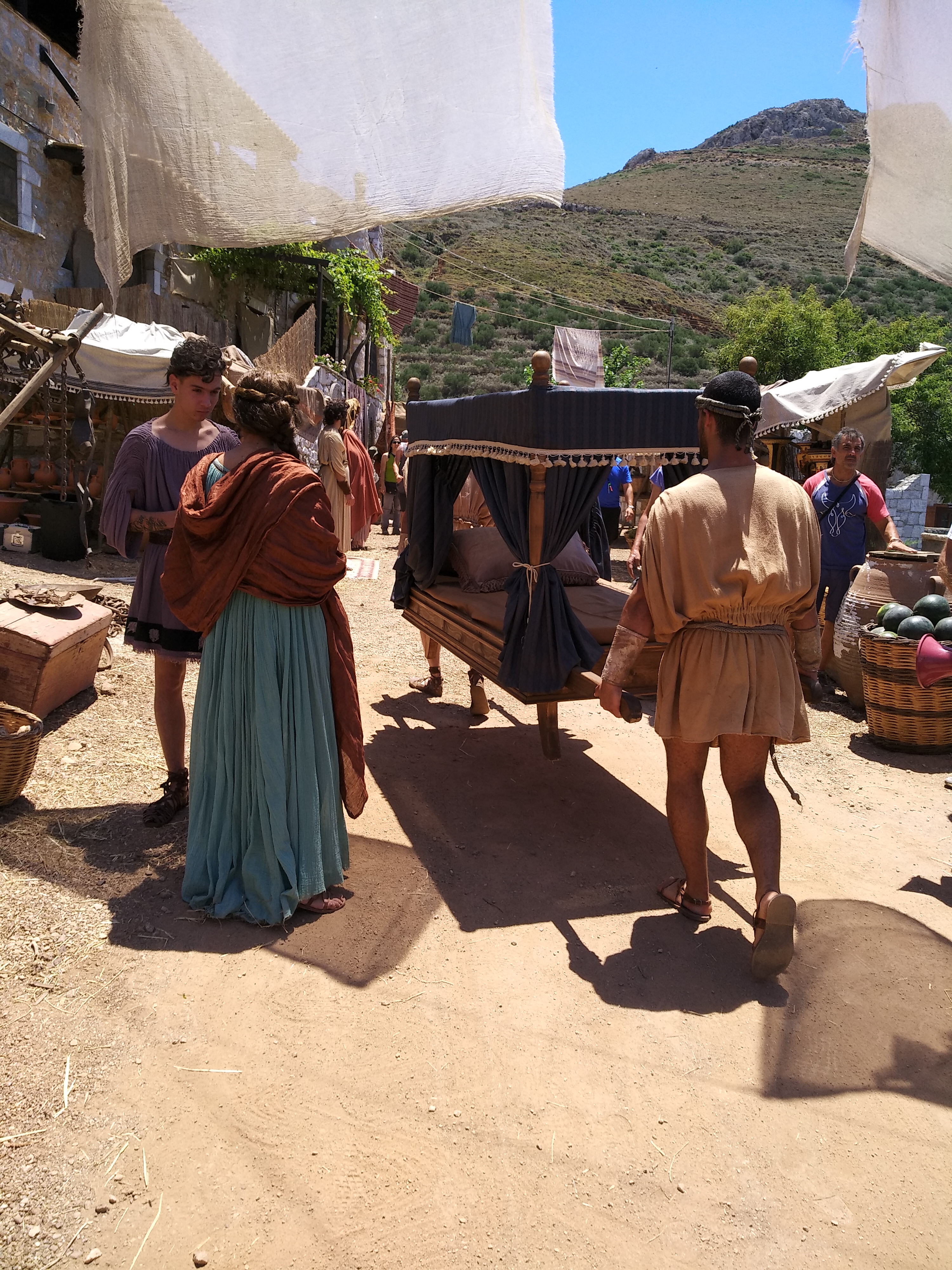
Hiring individual pieces can support a scene. Building a coherent environment requires spatial logic. An ancient kitchen, symposium, harbour, military camp, market or domestic interior must suggest how people cook, store, sit, trade, sleep, prepare, work and move. Furniture, textiles, vessels, tools and food need relationships.
We consider period and geography, camera positions, entrances and performer routes, foreground and background layers, concealed modern infrastructure, resets, sound, light, effects, anchoring, protection, installation and strike.
A convincing set often depends less on one spectacular centrepiece than on the density of ordinary life: a folded textile, a partially used work surface, stored vessels, rope, baskets and signs of human routine. But density must remain controlled. If every historical object owned by the supplier appears in one room, the result is not abundance. It is the ancient equivalent of a storage unit.
Greece is generous to the camera and difficult to the truck
Historical production in Greece benefits from exceptional landscapes, architecture, light and proximity to the Mediterranean worlds being represented. It also involves islands, narrow roads, heat, wind, stairs, ferries, restricted access, heritage-sensitive locations and schedules that occasionally assume a van can teleport.
Logistics must be designed with the visual concept. Can a vehicle reach the location? Where can it unload? Are stairs or narrow doors involved? Is a ferry required? How are fragile ceramics packed? Where do costumes remain dry and secure? Who signs the inventory? How long do installation and strike really require? What changes if the weather moves the schedule?
“The location is only a five-minute walk from the road” has caused more suffering than many epic journeys. Five minutes for a guest with a phone is not five minutes for a crew carrying armour, furniture and twelve boxes of ceramics over stone steps in August.
Packing is part of the design
A collection does not arrive safely because somebody wrote FRAGILE on the box with conviction. Ceramics, armour, textiles, weapons, furniture and food-contact objects require different packing, identification and handling.
Useful controls include item numbers, photographic records, packing lists by case, condition reports, assembly notes, scene or performer labels, separate identification of hero objects and duplicates, check-in responsibility and a quarantine area for wet, dirty or damaged returns.
If dismantling at two in the morning consists of throwing everything into the nearest available box, the next production begins with archaeology of the wrong kind.
Two small incidents that changed how we plan
During A Day in Ancient Greece in Rhodes, the historical table used reconstructed drinking vessels as working parts of service, interpretation and visual continuity. One visitor decided she wanted to buy all of them—immediately, while the event was still running. From her perspective, this was enthusiastic shopping. From ours, it meant continuing a historical drinking programme with no cups.
The incident exposed a real production issue. In public environments, sale stock, handling replicas, hero objects and operational equipment must be clearly separated. If an object attracts strong interest, one team member must be able to answer the question without dismantling the set during opening hours.
The programme also included a demonstration of ancient massage practices. After it ended, another visitor insisted that she should receive the massage for a photograph. The audience saw an experience still available; the team saw a completed activity, a performer needing a break and a running order already moving on. Reset time is not empty time. It is part of production. Both visitors offered a compliment in their own chaotic way: the objects and activities had become desirable enough to possess or enter. Our job was to protect that desire without allowing it to walk away with the cups or rewrite the schedule.

Hire, adaptation or bespoke construction?
Hire is appropriate when the collection contains the right period and visual language, quantities are sufficient, intended use is safe, measurements suit performers and the schedule allows preparation and return.
Adaptation is appropriate when a reversible change improves fit or function, camera-safe treatment is required, or additional dressing can transform an existing base. Bespoke construction is appropriate when the scene requires a specific hero object, dimensions or quantities do not exist, action needs a lighter or safer version, or a complete environment must be developed around the production design.
The cheapest solution at quotation stage is not always the cheapest solution on set. An unsuitable hired object can create fitting delays, continuity problems, reshoots or damage. Sometimes the honest answer is that an item needs to be built.
Availability and international delivery are project-specific
A photographed collection is not a promise that every item is waiting for every date. Objects may be committed elsewhere, under maintenance, undergoing research review or unsuitable for the proposed use. Costumes may fit one performer and not another. A set element may require a transport method incompatible with the location.
Archaeopolis supports productions in Greece, Europe and internationally. Depending on the project, we may ship existing material, travel with selected equipment and supervising personnel, or develop approved elements locally with production partners. International availability depends on destination, dates, packing, customs, insurance, intended handling and applicable regulations—particularly for weapons, armour and specialist equipment.
Availability is therefore confirmed against dates, risk, quantities, measurements, preparation, transport, supervision and return schedule. This protects both sides and prevents “background use” from unexpectedly meaning three days in seawater.
The agreement should describe reality
A professional hire agreement prevents people from remembering different versions of the same conversation. It should define the item list and condition, hire period, permitted use, locations, transport, fees, deposits, labour, fitting, installation, supervision, insurance, liability, loss, cleaning, extensions, cancellation, credits and return inspection.
If an object has restrictions, state them. If a costume cannot be altered, state it. If weapons require supervision, put it in writing. If intended use changes, it needs another conversation before the camera rolls. Clarity is considerably cheaper than an argument beside a damaged shield.
Credits matter too. Historical environments grow from research, craft and years of collection building. Where appropriate, records should identify the supplier, makers, specialist contributors, consultant, adaptations, supervisors, project, location, date and approved photography. Credits are not vanity. They are the map of who made the world possible.
What a useful enquiry looks like
The fastest route to an accurate response is a brief containing the production title and company, production type, historical period and geography, scene and intended use, required objects and costume roles, approximate quantities, performer measurements, dates and location, exposure to action, food, liquid, weather or effects, transport and installation needs, supervision, budget range and decision deadline.
Mood boards, marked-up scripts, plans and location photographs are useful. A screenshot of an object found online can begin a conversation, but it cannot answer whether that object belongs to the period, can be made safely or will fit through the door.
The right questions save time before the expensive people begin waiting. Archaeopolis can assess whether a production needs one hero object, a fitted group of costumes, a coordinated prop collection or a complete historically informed environment.
The aim is not to fill the frame
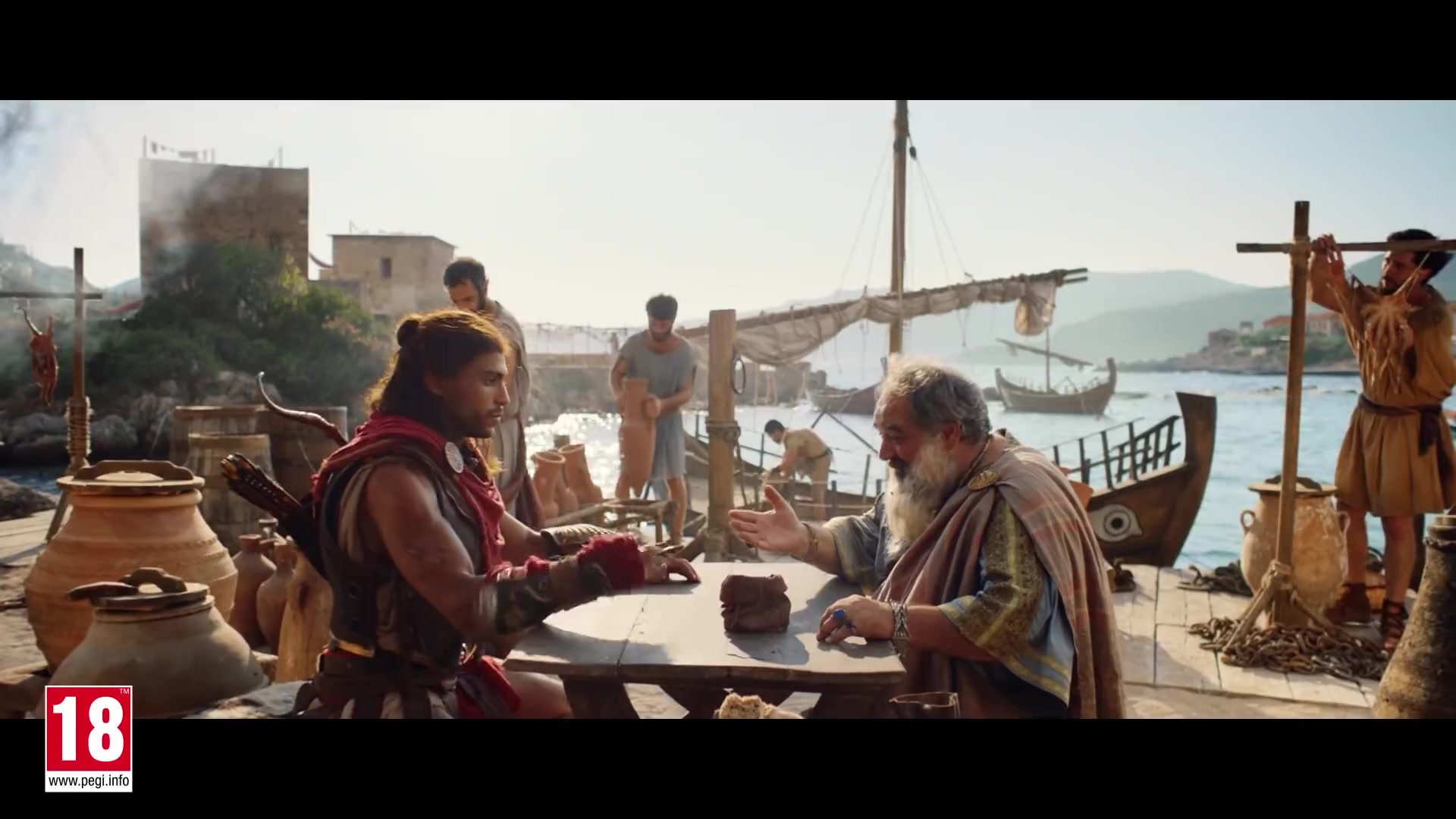
Historical props, costumes and sets determine how performers move, scenes are blocked, light behaves and whether the world feels coherent before a word is spoken. Strong production support does not simply deliver objects at the gate. It helps select, adapt, fit, dress, supervise, document and remove them without creating a second drama behind the camera.
At Archaeopolis, the collection belongs to a wider historical-production practice. Objects connect to research, clothing to movement, vessels to food, armour to supervised performance and set dressing to the logic of an environment.
The objective is not to make the frame look “historical”. It is to make the world inside the frame behave as though it belongs together—and to make sure it all returns in the correct boxes afterwards.
Evidence sets the boundaries. Production gives the encounter its life.
Editorial standard: this article distinguishes broad historical evidence from Archaeopolis production practice. Specific dates, artefacts and quotations will only be added with named sources.