The sea view deserves better
There is a quick way to create an “Ancient Greek experience”: send a few performers in white costumes, place plastic grapes on a table and hope the sea view does the rest.
The sea view deserves better.
A private historical experience should not feel like a public show squeezed into a villa or carried aboard a yacht. The gathering, setting and cultural idea should feel as though they were designed together from the beginning. That is the real potential of private Ancient Greek experiences in Greece.
The result may be an intimate symposium, a historical dinner, a family encounter with music and mythology, a programme of ancient physical practices, a tasting, a craft session or an entire evening combining food, objects, clothing, story and participation. The first question is not simply “What can we bring?” It is “What kind of world can exist naturally here, for these people, on this evening?”
Private does not merely mean fewer people
A private event is not a small public event. Guests are closer to the performers, every object is seen in greater detail and conversation becomes part of the experience. Timing is more flexible, but expectations are higher. There is nowhere for weak interpretation, poor materials or awkward hospitality to hide.
The work therefore begins with the group. Are the guests family, friends, clients or colleagues? Which languages do they speak? Are children or several generations involved? Do they want to participate or mainly observe? Is the occasion celebratory, educational, ceremonial, discreet or gloriously unserious?
The experience must meet people where they are. Nobody should feel that they have accidentally entered an examination in Classical civilisation while still wearing swimwear.
The location is already part of the scenography
A stone courtyard, an Aegean terrace, an olive grove, a contemporary villa, a yacht deck at sunset or a private beach each creates different opportunities and restrictions. Architecture, furniture, view, wind, sound and staff movement are already part of the production.
We read the setting before adding anything: where guests arrive, how the light changes, where music can be heard without dominating the property, how food travels from kitchen or galley to table, where performers prepare and which modern elements genuinely need to be softened.
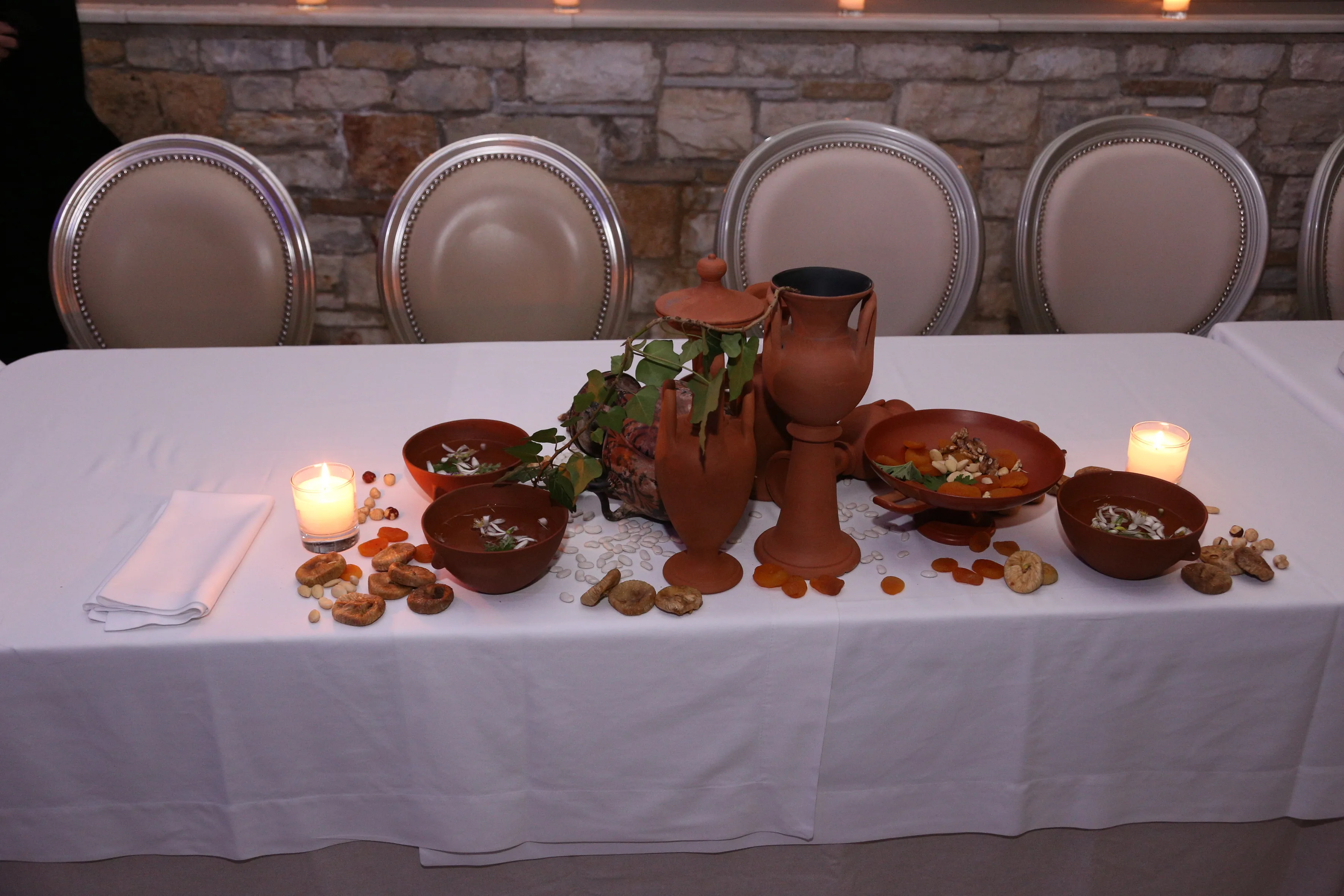
The objective is not to cover a beautiful location with “ancient” decoration until nobody can see why it was chosen. Greece already provides stone, water, wind and light. One table, the right vessels, carefully placed textiles, controlled lighting and human presence can do more than a warehouse of generic columns.
The private symposium
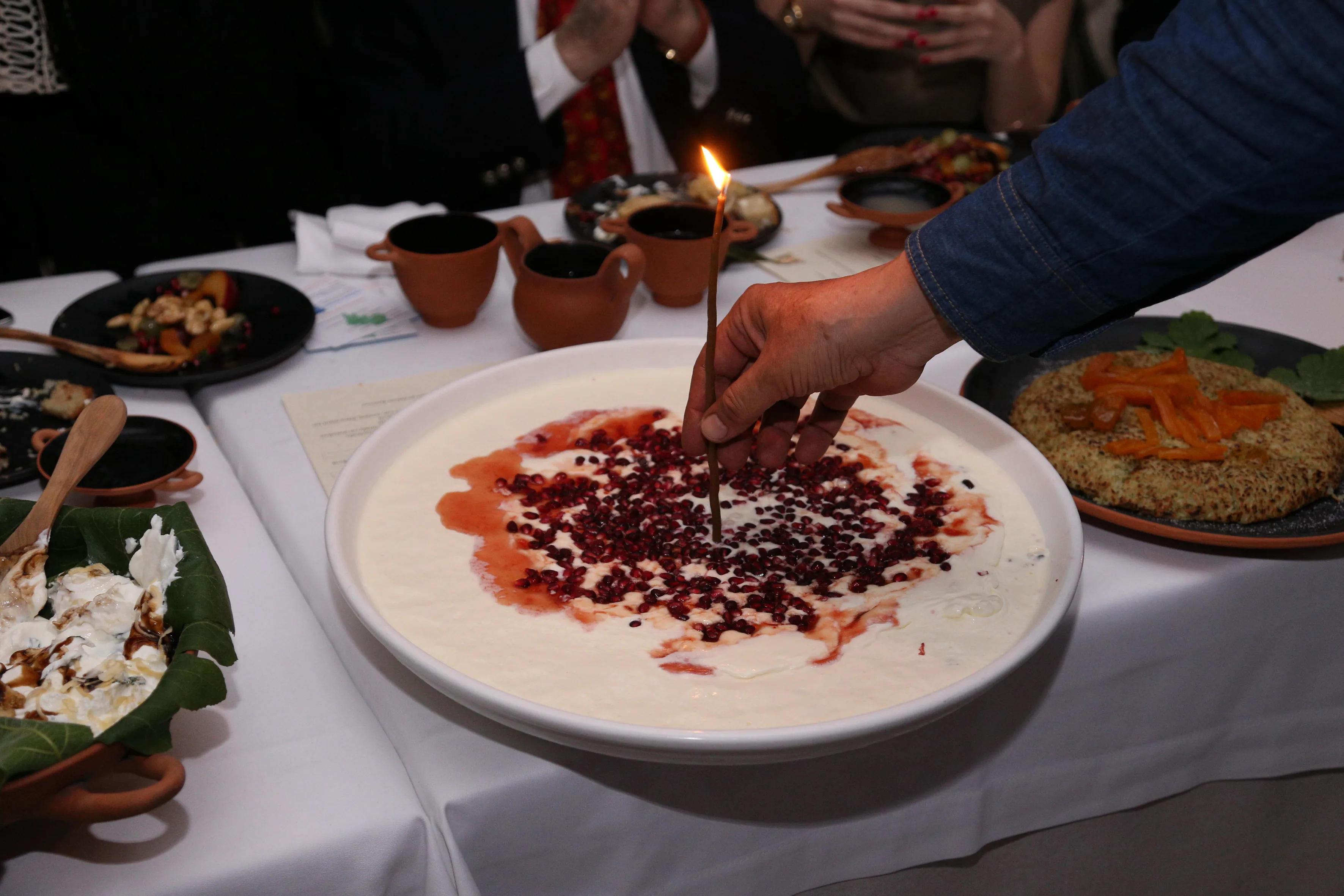
The symposium is one of the richest formats because it brings together food, wine, vessels, music, conversation, ritual, games and performance. It can become an intimate dinner, a guided tasting, a philosophical conversation, a playful programme of riddles and social games, or a complete dining environment with a specially developed menu and service.
The word symposium is often used today for a conference in which several people read slides while everybody else privately examines a phone. The ancient social form was rather more alive.
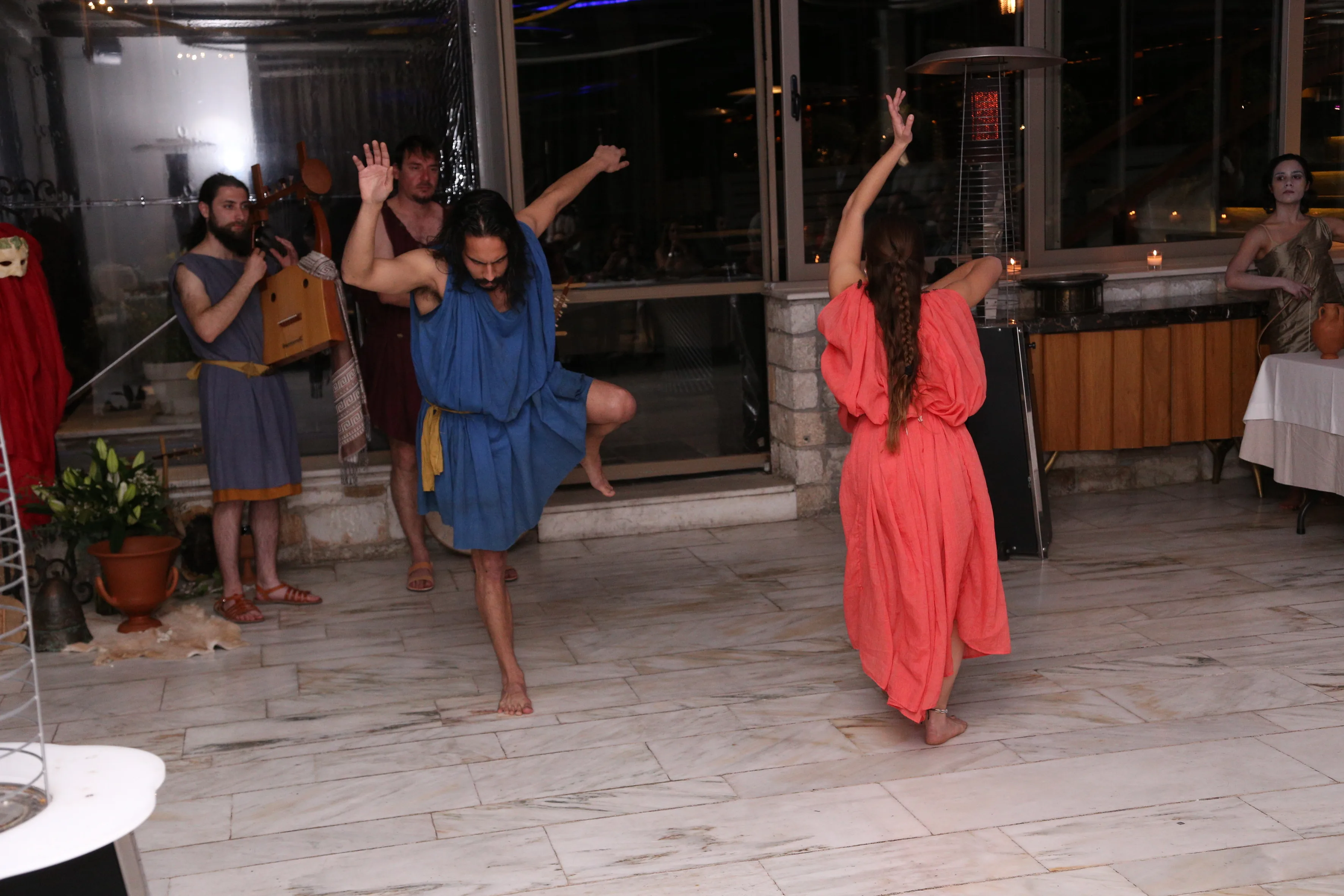
The challenge is to translate that life without imposing theatre upon the guests. Conversation and hospitality remain central. Musicians, performers and interpreters support the rhythm instead of hijacking dinner.
Historical gastronomy and private dining
Food offers the most immediate route into another period. A private historical menu can explore maritime trade and island ingredients, dining connected to Dionysos or Apollo, food and ancient medicine, or the contrast between daily meals and elite hospitality.
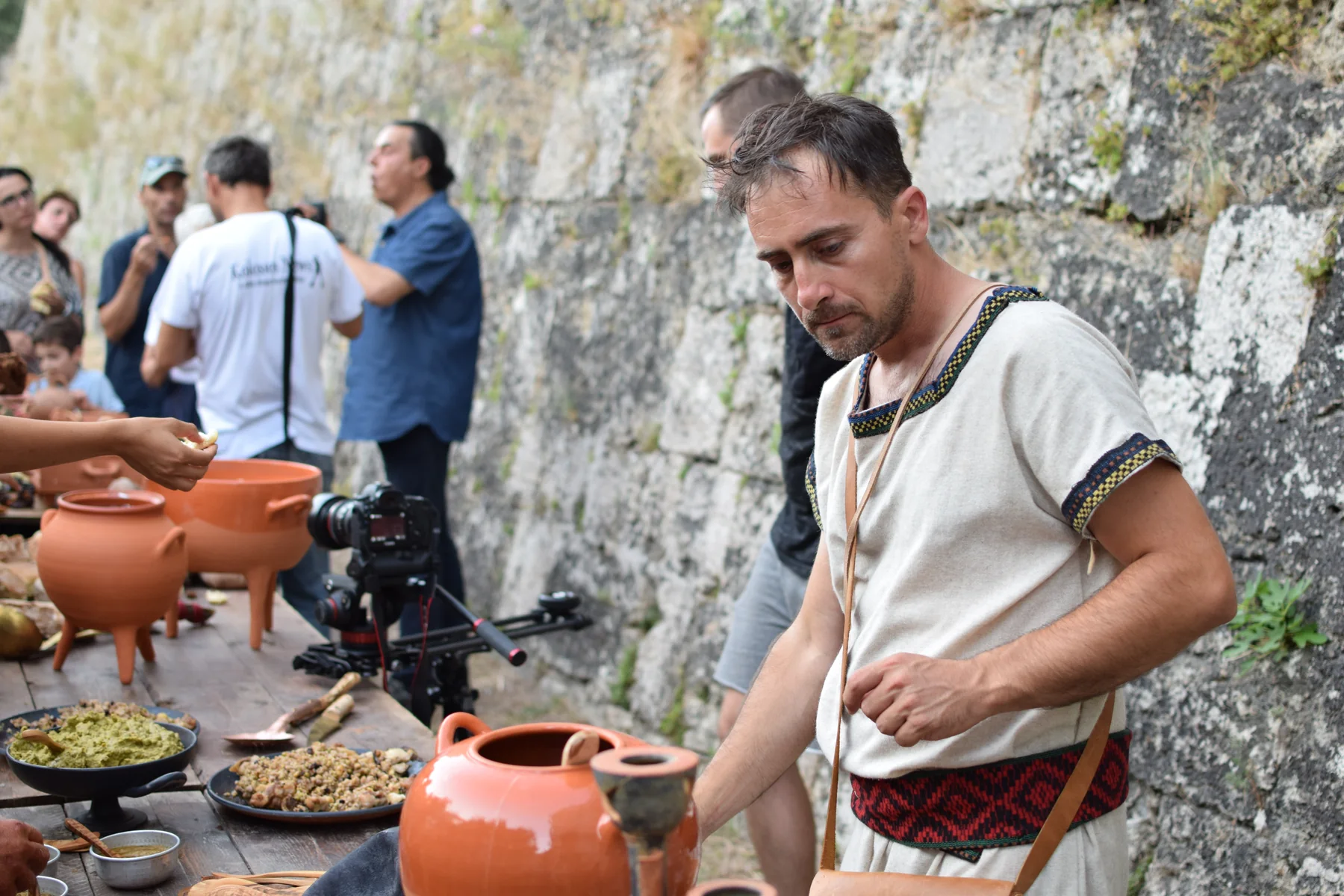
The menu must be historically grounded, operationally realistic and enjoyable. Guests should not have to suffer for authenticity; the ancient world had enough suffering of its own. Research, sourcing, food safety, preparation, tableware and service choreography form one production system, so the villa, yacht, hotel or catering team must be involved early.
The vessels matter as much as the dishes. They shape the table, the service and the way guests physically interact with the experience. They are not decorative extras beside standard glassware like unemployed actors.
Music, mythology and storytelling at human scale
Private groups allow sound and story to work at a distance where guests can notice the material and physical act of playing. A musician can introduce reconstructed or historically connected instruments and explain how sound belonged to social life, ritual and performance.
Mythological storytelling can respond to the location and journey. A yacht programme may explore sea travel, hospitality, danger and the long shadow of the Odyssey. A villa experience might focus on wine, love, music or the local landscape.
The point is not to recite the entire family tree of Zeus before dessert. It is to select stories that generate atmosphere and conversation. Ancient myths survived because families, desire, power and bad decisions provide inexhaustible material. Private groups usually recognise at least one of those subjects.
Objects change the conversation
A helmet, shield, cup, textile, bow, tool or domestic object gives guests access to scale, weight, texture and use. Depending on the object and supervision, they may handle a reconstruction, examine materials, explore how clothing changes movement or understand how vessels belong to food and social ritual.
Access must be designed. Not every object is available for unsupervised handling, and enthusiasm is not a recognised lifting technique.
During our public programme in Rhodes, one visitor wanted to buy every reconstructed drinking cup from the historical table while the event was still running. It was a sincere compliment and a potential operational catastrophe: we would have been left presenting a drinking culture with nothing to drink from. Objects intended for handling, sale or gifting must be planned separately from the equipment holding the experience together.
Clothing, identity and the dressed body
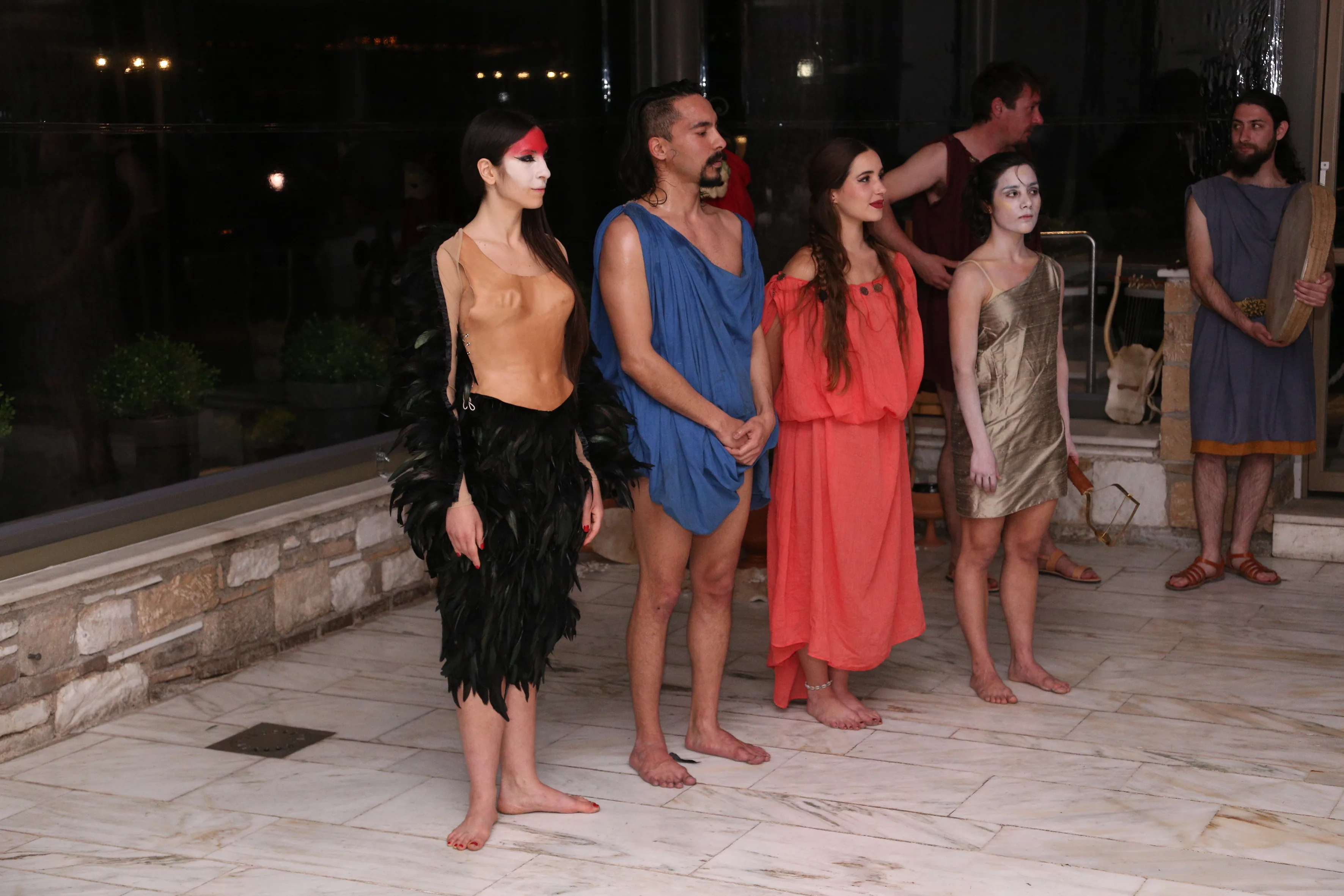
Historical clothing becomes meaningful when it is treated with more care than “put on a sheet and take a photograph.” A programme can explore fibres, weaving, dyes, fastening, status, ceremony and the relationship between clothing and movement. Selected fittings may be developed for guests or performers.
For photography, costume must fit, move and make sense in the environment. A badly arranged garment can make even an expensive villa look as though it is hosting a university toga party.
Private fittings also require sizing, dressing assistance, hygiene, time and clear boundaries around fragile items. The closer and more personal the encounter becomes, the more professional its handling must be.
Physical culture requires real supervision
Depending on the setting and group, the programme may include historical movement, introductory archery, shield and formation demonstrations, athletic practices, dance or interpretation of ancient body care.
These activities require experienced supervision, safe space, suitable equipment and realistic participation levels. A yacht deck is an excellent place for many things. It is not automatically an archery range because the horizon looks heroic.
At the Rhodes festival, a guest requested her own ancient-massage experience and photograph after the scheduled activity had finished. The request was amusing, but it revealed the gap between an audience’s sense that an experience remains available and a production’s need for boundaries, performer rest and reset time. In private programmes, participation is defined in advance while leaving enough flexibility for curiosity.
Composing the complete evening
For an important occasion, separate elements can become one continuous environment. Arrival may begin through music, fragrance or an object encounter. Drinks establish the cultural frame. Food carries interpretation through service rather than a lecture. Music, story or performance enters between courses. Participation follows through objects, games, movement or dress, before a final shared moment returns the gathering to the host.
The programme needs rhythm without being imprisoned by a stopwatch. Private hospitality must allow for conversation, late arrivals, children changing the plan and the mysterious period between courses during which everybody decides to take photographs.
The evening is fully produced. It should never feel overproduced.
Villas require discretion
A private villa is somebody’s temporary home. Production must enter and leave without taking possession of it. Property access, delivery routes, kitchen arrangements, furniture movement, neighbours, privacy, dressing areas, weather alternatives and restoration of the space all belong in the plan.
The best production leaves no visible evidence the next morning except photographs and perhaps one guest still discussing the wine vessel. Names, images, dates and locations may also need to remain private. Photography and publication permissions are agreed rather than assumed.
Yachts change every logistical assumption
A yacht offers extraordinary intimacy and a direct relationship with the sea. It also has strict operational realities. Storage is limited, access may involve tenders and narrow gangways, wind changes textiles and sound, ceramic objects require secure placement and some activities may be inappropriate altogether.
The captain and crew must confirm embarkation, available space, route, sea conditions, storage, galley coordination, sound, power, object security, footwear, movement and safety requirements. The captain has final authority over the vessel. Poseidon may be culturally relevant, but he is not an acceptable production manager.
Yacht experiences usually benefit from intelligent reduction: fewer objects, stronger choices, lighter staging and closer human interaction. The sea is already doing much of the work.
Families need parallel doors into the same world
A multigenerational programme should not divide the group into serious adults and children being kept busy elsewhere. One cultural world can offer several levels of entry: adults explore context and gastronomy, children handle safe objects or make something, grandparents choose music and conversation, and teenagers discover armour, mythology, photography or movement.
Nobody needs to join every activity. The group reconnects at a shared table or performance. Children are also excellent quality control. If an explanation is dull, they will not preserve diplomatic relations for the sake of the organiser.
Luxury means coherence, not excess
Private clients do not need more material simply because the setting is expensive. Luxury here means beautiful and historically informed objects, performers who understand both history and hospitality, meaningful food, discreet technical support, participation without embarrassment and privacy without coldness.
Gold paint is not a substitute for coherence. Neither are ten performers when three exceptional people would create a better encounter. The production should feel generous, not desperate to prove its budget.
What belongs in the brief
A useful enquiry includes the location and type of property or vessel, preferred date, duration, guest number and ages, languages, occasion, desired participation, cultural interests, food or performance requirements, access and privacy restrictions, and indicative production budget.
It is perfectly acceptable not to know the final concept. Developing it is part of our work. But “something Greek, elegant and unforgettable” still needs a location, a guest count and a budget before Apollo can begin scheduling musicians.
What should remain after the objects leave?
The objects leave. The performers leave. The table returns to normal use. The yacht moves to another harbour and the villa prepares for another morning.
What remains should be more than a photograph of people in costume. A guest should remember a flavour, a story, the weight of an object, the sound of an instrument, the changing light or a conversation that would not have happened during an ordinary dinner.
That is the measure of a private cultural experience: not how much material was installed, but how precisely the evening belonged to those people in that place. Archaeopolis combines research, historical gastronomy, material culture, music, performance, objects and production at different scales. The ancient world is not delivered to a villa or yacht in a box. The box contains the vessels. The world still has to be created.
Evidence sets the boundaries. Production gives the encounter its life.
Editorial standard: this article distinguishes broad historical evidence from Archaeopolis production practice. Specific dates, artefacts and quotations will only be added with named sources.